
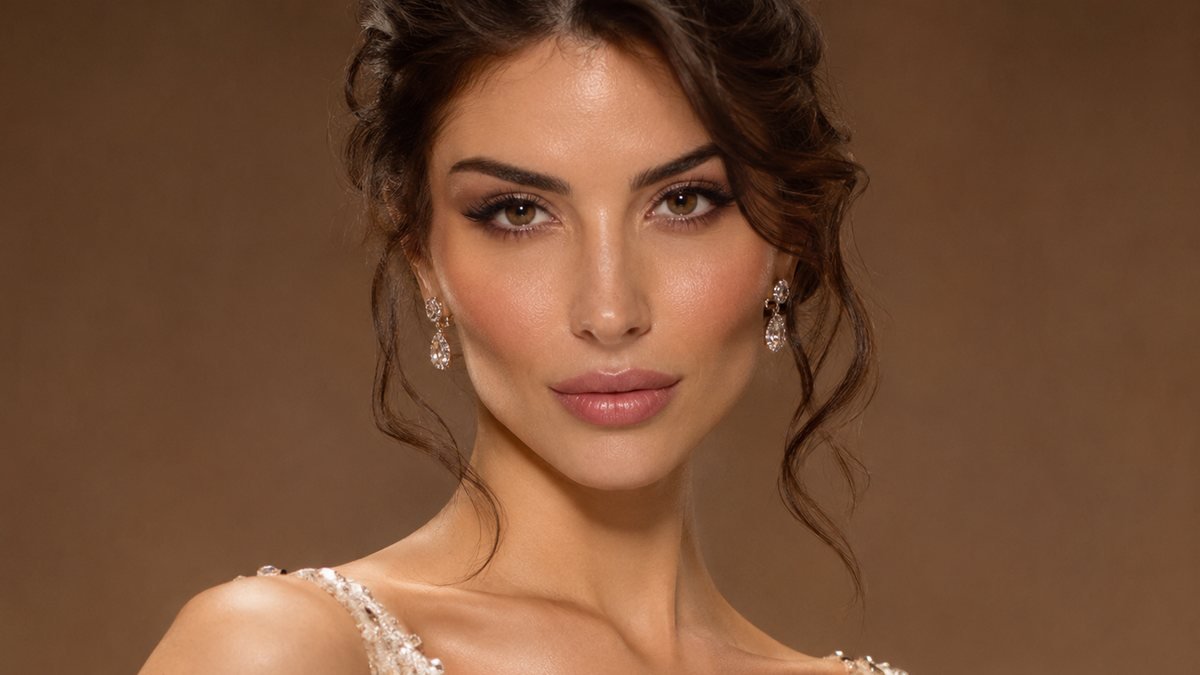
If you have prominent, high cheekbones paired with a narrow forehead and a neatly tapered chin, you likely have a diamond face shape. This distinct silhouette is defined by dramatic angles and elegant proportions. It gets its name because the middle of the face forms the widest point, tapering sharply at both the top and bottom much like a cut gemstone.
The diamond silhouette is often described as the rarest face shape among standard styling classifications. While many people share traits of oval or round structures, fewer present the specific combination of a slender forehead, dramatic cheek width, and a narrow, pointed jaw line.
Understanding your facial geometry is not about fitting into a rigid box or measuring up to a standard of beauty. Instead, it serves as a practical blueprint for choosing haircuts, eyebrow shapes, and eyewear frames that bring out your natural features. In this guide, we will break down how to identify a diamond face shape, how it compares to similar structures, and the simple styling techniques that suit it best.
How to Tell If You Have a Diamond Face Shape
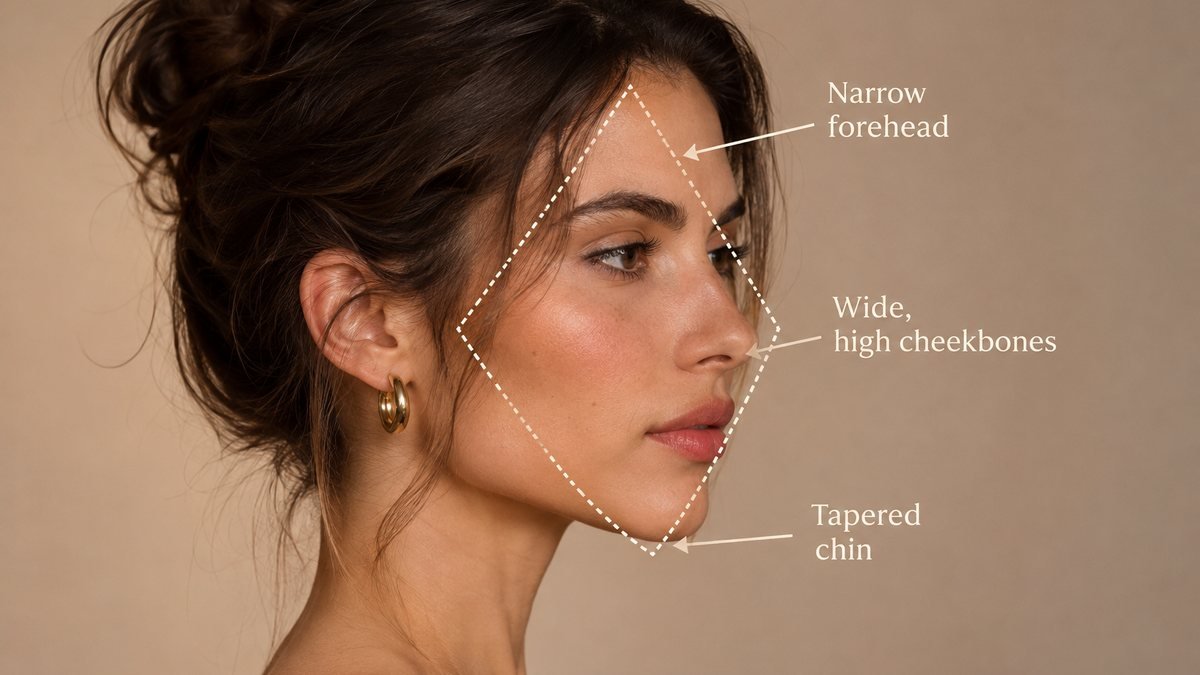
Identifying your face shape comes down to looking at the proportions between your forehead, cheekbones, and jaw. While everyone's facial structure is unique, a classic diamond face shape consistently exhibits four key visual signs:
- A narrow forehead: Your hairline is noticeably narrower than the span of your cheekbones. It often tapers slightly inward toward the top of your head.
- High, wide cheekbones: Your cheekbones form the widest horizontal measurement of your face. They sit high, giving the mid-face a sculpted, angled appearance.
- A slender jawline: Your jaw slopes inward smoothly without the wide, square corners found in square or rectangle shapes.
- A pointed chin: The base of your face ends in a defined, delicate point rather than a soft curve or flat edge.
When you evaluate your face in a mirror, look closely at the relationship between these three main zones. On a diamond shaped face, the cheekbone width is significantly greater than both the forehead width and the jawline width.
Furthermore, the forehead and jawline are typically similar to each other in width. The total length of the face—measured from the top of the hairline to the tip of the chin—is also noticeably longer than the width, giving the face a balanced, elongated appearance rather than a short or round one.
Diamond vs Heart vs Oval: The Differences That Matter
It is common to confuse a diamond face shape with a heart or oval shape. Because all three of these silhouettes feature a tapered chin and balanced length, distinguishing between them can sometimes feel tricky.
The primary difference lies in where the face reaches its widest point, as well as the shape of the hairline. A heart shape is widest at the top of the face, featuring a broad forehead that often includes a central widow's peak. An oval shape is evenly balanced throughout, with soft, rounded contours rather than sharp angles. A diamond face, by contrast, reaches its maximum width strictly at the cheekbones.
Here is a simple breakdown of how these three face shapes compare side by side:
| Feature | Diamond Face Shape | Heart Face Shape | Oval Face Shape |
|---|---|---|---|
| Forehead Width | Narrow; narrower than cheekbones | Broad and wide; often the widest area | Medium; slightly wider than the jaw |
| Cheekbone Width | Widest part of the face | Slightly narrower than the forehead | Balanced; wide, but transitions softly |
| Jaw and Chin | Tapered jaw with a sharply pointed chin | Tapered jaw with a narrow or pointed chin | Softly rounded jawline and smooth chin |
| Overall Outline | Angular, dramatic, gem-like contour | Inverted triangle with top-heavy volume | Gently curved, balanced egg shape |
Evaluating the diamond vs heart face shape comparison comes down to checking your forehead. If your forehead is wide and feels like the dominant feature of your upper face, you are likely a heart shape. If your forehead narrows in and your cheekbones steal the spotlight, you are dealing with a diamond structure.
How to Measure Your Face Shape at Home

If looking in the mirror leaves you uncertain, taking four basic measurements can help you clarify your structure. You can do this using a soft, flexible tailor's tape measure, or by taking a flat, straight-on photo of your face and marking lines on it.
Follow these simple steps to record your dimensions:
- Forehead width: Measure across the widest part of your forehead, halfway between your eyebrows and your upper hairline.
- Cheekbone width: Measure across the highest point of your cheekbones, starting from the outer corner of one eye across to the outer corner of the other.
- Jawline width: Measure from the base of your jaw beneath your ear down to the center tip of your chin. Multiply that number by two to get your total jawline span.
- Face length: Measure straight down the center line of your face, starting from your front hairline down to the bottom tip of your chin.
Once you have recorded these numbers, look for the numerical pattern. A diamond face shape will show a clear hierarchy: your cheekbone measurement will be the largest number by a noticeable margin. Your forehead and jawline measurements will both be smaller than the cheekbones, and they will usually be relatively close to each other in size. Finally, your face length will be larger than your cheekbone width.
If you prefer a fast, visual way to double-check your proportions without drawing on photos or using a tape measure, you can upload a clear photo to the face shape detector at FaceAgeCalc to get a visual estimate of your outline.
Hairstyles That Suit a Diamond Face Shape
When selecting diamond face shape hairstyles, the primary objective is balance. Because your cheekbones are naturally defined and wide, smart hair styling focuses on adding visual fullness to the narrower top and bottom zones—the forehead and the jawline—while softening sharp cheek angles.
Here are six versatile hairstyles that complement a diamond face shape exceptionally well:
- Side-Swept Bangs: Soft, angled bangs across the forehead create the illusion of width across a narrow upper face while gently framing the eyes.
- Chin-Length Bobs: A classical bob that ends right at the chin line adds volume around the jaw, filling out the narrow lower third of your face.
- Long, Textured Layers: Layers that start around the chin or collarbone add movement and softness around the lower face, easing the transition from high cheekbones down to the chin.
- Deep Side Parts: Shifting your part to one side breaks up symmetry, softening dramatic cheek lines and drawing attention upward to your eyes.
- Soft Waves and Curls: Loose waves that kick out from the jawline down build width where your face is naturally slender, balancing high cheekbones.
- Curtain Bangs: Center-parted curtain bangs that sweep open near the brow line widen the visual look of the forehead while gently skimming over wide cheekbones.
Styles to Be Careful With
Just as certain cuts accentuate your best features, a few styles can throw off your natural balance. If you want to keep your proportions even, approach these looks with care:
- Slicked-back high ponytails: Pulling all your hair tightly off your face emphasizes a narrow forehead and exposes wide cheekbones with no softening contrast.
- Flat center parts on straight long hair: Pin-straight hair hanging flat against the temples highlights a narrow upper hairline and makes cheekbones appear wider by comparison.
- Excessive volume only at cheek height: Cuts that add thick volume right at the ear or cheek level double down on the widest zone of your face.
Glasses and Sunglasses for a Diamond Face Shape
Finding flattering diamond face shape glasses means picking frames that bring horizontal harmony to your face. Because your cheekbones are already prominent, the goal is to choose eyewear that widens the visual appearance of your brow line without sitting heavily on your cheeks.
Frame Shapes That Work Well
- Cat-Eye Frames: The upward sweep of cat-eye glasses lifts the eye area and broadens a narrow forehead, perfectly matching high cheekbones.
- Browline and Clubmaster Styles: Frames with prominent upper rims add structure and visual width across your brow area, balancing out a tapered chin.
- Oval and Rounded Frames: Soft curves help break up sharp facial angles and pointed chins, creating a gentler, balanced look.
- Semi-Rimless or Rimless Frames: Delicate frames avoid adding bulky lines across the middle of your face, letting your natural cheek structure stay the focus without visual overcrowding.
Frame Shapes to Avoid
- Very Narrow or Small Frames: Tiny frames make high cheekbones look wider than they actually are by leaving too much face space exposed.
- Boxy, Rigid Rectangles: Sharp, blocky frames clash with the dramatic natural angles of a diamond structure and can make your mid-face look harsh.
- Overly Large Oversized Frames: Heavy, massive frames that rest directly on your cheekbones obscure your features and emphasize low jaw volume.
Makeup Tips for a Diamond Face Shape
Makeup application for a diamond face shape focuses on bringing light to the narrow central axis of your face while softly sculpting the outer edges of your cheekbones. By placing highlight and contour strategically, you can create a soft, harmonious finish.
Contour Placement
Because your cheekbones are already defined, you do not need heavy contouring beneath them. Instead, apply a small amount of contour product along the outer edges of your cheekbones, near your hairline and ears. This subtly recedes the widest points of your face. Avoid sweeping contour deep into the hollows of your cheeks toward your mouth, as this can make your face look overly drawn.
Highlighting and Brightening
Use a matte highlighter or a light concealer to add brightness down the center line of your face. Focus on two main areas: the middle of your forehead and the tip of your chin. Brightening the center of your forehead gives it an open, wider appearance, while illuminating the chin softens its sharp point.
Blush Placement
Apply blush slightly lower than you normally would—on the lower half of the apples of your cheeks—and blend out horizontally toward your ears. This horizontal blending creates the illusion of fullness across the mid-face without making your cheekbones look higher or sharper.
Eyebrow Shape
Eyebrows set the frame for your upper face. For a diamond shape, softly rounded brows with a gentle arch work best. A soft curve softens sharp cheek angles and neutralizes a pointed chin. Avoid sharp, highly pointed eyebrow arches, which repeat the angular look of your chin and cheekbones.
Famous Faces With a Diamond Face Shape
While celebrity face shape classifications rely on photo observation rather than precise physical measurements, several well-known figures are frequently cited by stylists as having classic diamond characteristics:
- Halle Berry: Often referenced as a classic diamond shape, featuring high, striking cheekbones, a petite forehead, and a tapered jawline.
- Jennifer Lopez: Known for her prominent, sculpted cheekbones paired with a narrow hairline and a well-defined chin structure.
- Megan Fox: Frequently highlighted for her angular cheek structure that tapers into a slender, delicate chin.
- Rihanna: Widely cited for her high cheekbone width and distinct, tapered facial proportions that suit a variety of versatile hairstyles.
Observing how these famous figures wear their hair—often in soft, face-framing waves, side parts, or sweeping bangs—shows how practical styling ideas work on real faces.
Diamond Face Shape FAQs
Is diamond the rarest face shape?
Yes, diamond is widely considered the rarest face shape in classical beauty and styling frameworks. This is because it requires a specific combination of features: high cheekbones that are visibly wider than both a slender forehead and a slender jawline simultaneously.
Can your face shape change over time?
While your underlying facial bone structure remains mostly stable after adulthood, your apparent face shape can evolve. Factors such as weight fluctuations, natural changes in facial fat distribution, aging skin elasticity, and dental changes can adjust how rounded or angular your contours appear over the years.
Diamond or heart — how do I know which one I have?
Look closely at your forehead width relative to your cheekbones. If your forehead is the widest part of your face and you have a broad hairline, you have a heart face shape. If your forehead is narrow and your cheekbones form the widest point of your face, you have a diamond shape.
What hairstyle should a diamond face shape avoid?
You should generally avoid slicked-back styles with no height or fringe, flat center parts on long pin-straight hair, and short haircuts that place volume exclusively around the ears. These styles exaggerate wide cheekbones while making a narrow forehead and chin look smaller.
Are diamond face shapes attractive?
Face shape classifications are merely tools for styling hair, makeup, and accessories—they are not a measure of beauty or attractiveness. That said, diamond face shapes are frequently celebrated in modeling and photography for their high, sculpted cheekbones and defined jawlines. ---
Finding Your Personal Style Balance
Understanding your face shape gives you a helpful reference point whenever you want to try a new haircut, pick out new glasses, or adjust your makeup routine. If you have a diamond face shape, your high cheekbones and defined angles provide a dramatic, sculpted foundation.
Focus on choices that add width to your forehead and jaw, soften sharp cheek lines, and celebrate your natural features. Remember that styling recommendations are guidelines rather than strict rules—wear whatever makes you feel comfortable and confident.
If you are curious to double-check your face shape quickly from a photo, try out the automatic face shape detector at FaceAgeCalc to get a helpful visual reference from your photo.