
Choosing a haircut depending on face shape can help you narrow a crowded list of styles—but it should not make the decision for you. A cut that looks polished in a reference photo may behave differently with your hair texture, density, hairline, and everyday routine. The goal is not to “correct” your face. It is to find a shape, length, and amount of movement that you enjoy wearing.
This guide covers six common face-shape descriptions, haircut ideas for men and women, texture adjustments, and a practical checklist for your next salon or barber visit. Treat the suggestions as options, not rules.
How Face Shape Helps You Choose a Haircut
Hair creates an outline around the face. Length, fringe, parting, layers, and volume can change that outline: crown height adds vertical emphasis, fullness near the cheeks adds width, and face-framing pieces draw attention to the jaw or cheekbones.
Use face-shape advice to describe an effect—not to find one “correct” haircut. Sam Villa’s stylist guide likewise emphasizes personalization, texture, and lifestyle.
No face shape is a standard everyone needs to aim for. Decide what you want to emphasize, what movement you like, and how much styling you want to do on an ordinary morning.
How to Identify Your Face Shape
You do not need exact measurements for a first estimate. In even light, pull your hair away from your forehead and look straight ahead. Compare forehead width, cheekbone width, jawline shape, and face length from hairline to chin. If you want to understand what actually determines your face shape, read our guide on how face shape works and what can naturally change.
- Find the widest area: forehead, cheekbones, or jaw.
- Compare width and length: is the face noticeably longer than it is wide?
- Check the jaw and chin: are they rounded, angular, broad, or pointed?
- Use a clear view: close selfies can distort proportions, and hair, lighting, and camera angle affect the outline.
Face-shape names are styling descriptions, not a universal classification, and many people sit between categories. “Heart” and “inverted triangle” may overlap, as can “oblong” and “rectangular.” An online face-shape detector, if you choose to use one, can offer an estimate rather than a definitive assessment.
Haircut Ideas Depending on Face Shape
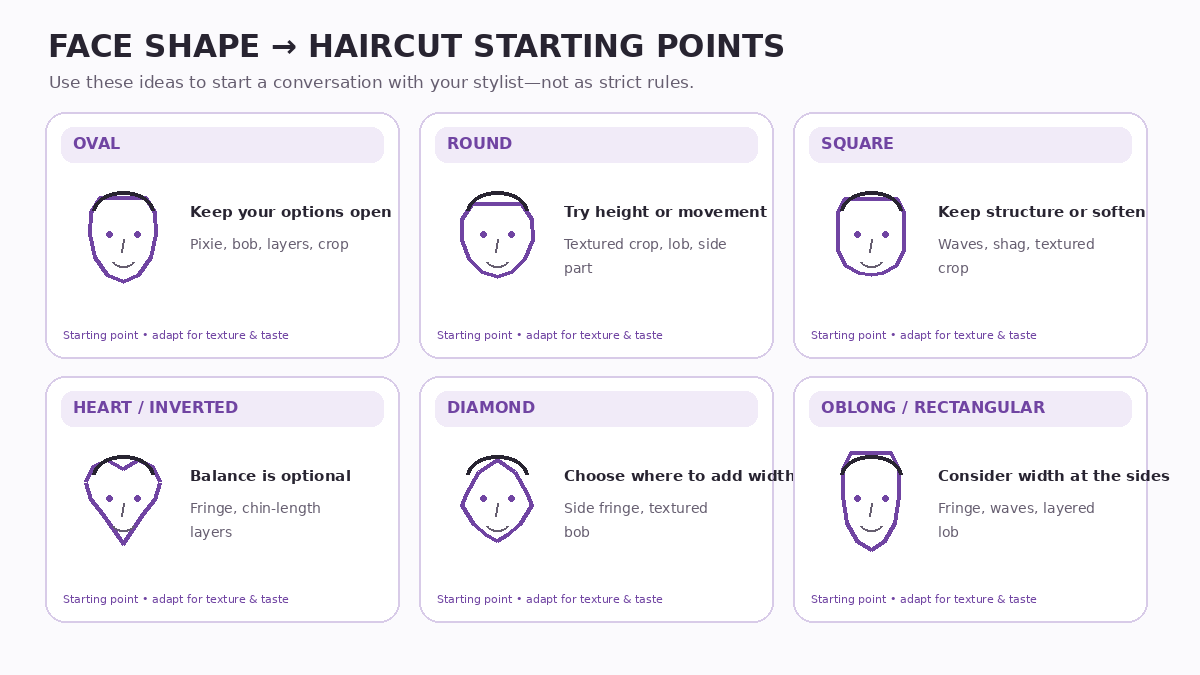
This table turns common face-shape descriptions into starting points: a possible visual effect, cuts to explore, and a texture adjustment. These are not “best and worst” rankings; you can emphasize your natural proportions instead of trying to balance them.
| Face shape | Possible styling direction | Haircuts to explore | Texture adjustment |
|---|---|---|---|
| Oval | Keep flexibility; emphasize a feature you like | Pixie, bob, lob, long layers, textured crop, side part | For fine hair, preserve enough weight; for curls, shape the silhouette around natural spring. |
| Round | Try height, asymmetry, or movement if you want a more vertical outline | Layered lob, textured pixie, side part, quiff, textured crop | Place volume intentionally; do not remove all side fullness if you like a softer shape. |
| Square | Keep the jaw defined or soften its edges | Mid-length bob, shag, soft layers, crew cut, textured crop | Waves and curls can add movement; clean, blunt lines can deliberately emphasize structure. |
| Oblong / rectangular | Consider width at the sides or fringe if you want to reduce the appearance of length | Cheekbone layers, fringe, shoulder-length waves, side-swept crop | Be cautious with excessive crown height if you prefer a less elongated silhouette. |
| Heart / inverted triangle | Experiment with forehead framing or fullness near the jaw | Curtain bangs, side-swept fringe, chin-length bob, medium layers | Adapt fringe to growth patterns and curls; choose upper volume only if you like the effect. |
| Diamond | Decide where to add softness or width around prominent cheekbones | Side fringe, textured bob, face-framing layers, fuller crop | Discuss where layers begin and how much fullness to keep near the temples and jaw. |
Oval face shape
Oval proportions are often described as versatile: the face is longer than it is wide, and the jaw is usually a little narrower than the forehead. Explore a textured crop, quiff, pixie, bob, lob, side part, or long layers. Choose based on the feature you want to highlight, your hairline, and your styling habits.
Round face shape
A round face often has similar width and length, full cheeks, and a soft jaw. For more vertical emphasis, try a side part, layered lob, textured crop, or some crown height. You do not need to hide a round outline: short hair can work, and volume placement matters more than choosing long hair by default.
Square face shape
A square face is commonly described by a broad forehead and defined jaw of similar width. Emphasize the structure with a crew cut, blunt bob, or clean outline, or add movement with waves, layers, a shag, or side-swept fringe. A Byrdie bob guide shows how length, texture, and fringe can change the effect.
Oblong or rectangular face shape
An oblong or rectangular face is visibly longer than it is wide. To add side width, consider cheekbone-level layers, waves, fringe, or a medium-length cut. For short hair, discuss a side-swept crop or balanced top and sides. Crown height adds length visually, but it is not wrong if you like that effect.
Heart or inverted-triangle face shape
These terms often describe a broader forehead narrowing toward the chin, though guides vary in how they use them. Try curtain bangs, side-swept fringe, a chin-length bob, or layers with movement near the lower face. No single hairline feature defines the category; compare forehead, cheekbones, jaw, and chin together.
Diamond face shape
A diamond-shaped outline is usually widest at the cheekbones, with a narrower forehead and chin. Try side-swept fringe, face-framing layers, a textured bob, or a crop with fullness near the temples. If you like emphasizing your cheekbones, a tucked-back or sculpted style can work too. Choose the effect intentionally rather than hiding a feature.
Men’s Haircuts: Choosing the Top, Sides, and Fringe
For men, the top, sides, fringe, neckline, and beard all affect the silhouette. A fade or taper describes the sides; it does not determine whether the entire cut suits your hair or preferences. Your jawline shape also plays a role in which cuts look most balanced.
- Oval: Try a textured crop, crew cut, side part, quiff, buzz cut, undercut, pompadour, or longer layers.
- Round: A textured crop, side part, or moderate crown height adds contrast; a taper keeps the outline neat.
- Square: A crew cut, buzz cut, side part, or medium scissor cut can emphasize the jaw; waves add movement.
- Oblong / rectangular: Consider a fringe, textured crop, or balanced top and sides. A tall quiff adds vertical emphasis.
- Heart / inverted triangle: Side-swept fringe or medium texture can frame the forehead; slicked-back hair exposes it.
- Diamond: Try a side fringe or crop with some fullness near the temples. Tight sides emphasize the cheekbones.
Beard shape can also change the outline: length at the chin may visually extend the lower face, while fullness at the sides can add width. Tell your barber how you want the haircut and beard to work together. Tim Carr’s haircut guide also highlights texture, lifestyle, and reference photos.
Women’s Haircuts: Choosing Length, Layers, and Bangs
Start with a length you want to maintain, then decide where layers and fringe should sit. Pixies, bobs, lobs, shags, and long layers can work across face shapes. The perimeter, weight removal, and fringe shape often matter more than the haircut’s name.
Short cuts: pixies and crops
A pixie shows the jaw, cheekbones, and neck, while longer fringe or temple pieces can soften the frame. Ask how the cut will retain body in fine hair or account for shrinkage in curly and coily hair. Short hair is not reserved for one face shape.
Medium cuts: bobs, lobs, and shags
A bob or lob changes character depending on whether its ends sit above, at, or below the jaw. Layers add movement; a one-length perimeter can preserve weight. With a shag, ask where the shortest layers will land and how they will work with your natural parting.
Long cuts: layers and face-framing pieces
Long hair can be sleek, wavy, curly, or layered near the cheekbones, jaw, or collarbone. Face-framing pieces may need styling to sit as intended, so tell your stylist if you usually air-dry your hair.
Curtain bangs open at the centre, side-swept fringe creates a diagonal line, blunt bangs make a strong horizontal line, and wispy fringe offers lighter coverage. Choose based on texture, hairline, and comfort—not face shape alone.
Adjust the Choice for Your Actual Hair
The same reference photo can produce different results because hair behaves differently. Face shape suggests a silhouette; texture and density influence how it sits. Consider these factors:
- Straight hair: Blunt ends show clean lines; subtle layers add movement. Ask how the cut will sit without heat styling.
- Wavy hair: Layers can shape waves, but placement matters. Bring a photo of your natural texture.
- Curly or coily hair: Shrinkage and volume change the finished outline. Ask how the stylist will cut and account for curl pattern.
- Fine strands or low density: Fine describes strand diameter; density describes how much hair grows in an area. Too many layers may reduce fullness.
- Thick or dense hair: Weight removal can help movement, but excessive thinning may be harder to manage.
- Growth patterns: Cowlicks, crown whorls, and natural parting affect how a fringe or crop sits.
Be honest about maintenance: trim frequency, products, styling time, and upkeep budget all matter. A cut that looks great after a salon blowout may not fit a wash-and-go routine.
What to Ask Your Barber or Stylist

You do not need the exact haircut name. Bring two or three reference photos—ideally front, side, and back views—and explain what you like. Choose examples with hair texture and density similar to yours, and say what you would change.
Use this checklist before the appointment:
- Length: What should stay, and how short can the top, sides, fringe, or ends go?
- Shape: Should the cut emphasize the jaw or cheekbones, soften the outline, or add width?
- Texture: How will it work with your natural hair pattern?
- Styling: How will it look air-dried, and which products or tools are needed?
- Maintenance: How often will it need reshaping?
- Adaptation: What needs to change because of your hairline, density, or growth pattern?
You might say: “I like the length and movement in this photo, but I want a version that works with my natural texture and my usual styling routine.” Ask the stylist to explain any trade-offs before cutting. Choose the option that fits your comfort and routine; face-shape advice should expand your choices, not box you in. Choosing a haircut depending on face shape is a starting point, not a rule — the best cut is one you feel confident wearing.
Frequently Asked Questions
How do I choose a haircut if I have a mixed face shape?
Treat face-shape labels as shorthand, not a test you must pass. Notice your dominant proportions—such as a wider forehead, prominent cheekbones, or a defined jaw—and decide what you want the haircut to emphasize. A stylist can combine ideas from more than one category.
Can a round face suit short hair?
Yes. A pixie, textured crop, or short bob can work with a round face. Consider where the sides end and how much volume sits at the crown, but there is no rule that a round face requires long hair. Ask your stylist to adapt the cut to your texture and preferences.
Does an oval face suit every haircut?
An oval face is often described as versatile, but no face shape automatically suits every cut. Hairline, density, curl pattern, neck length, styling habits, and personal taste all affect the result. Use face shape to build a shortlist, then judge each style against your actual hair and routine.
How do I choose bangs for my face shape?
Start with the effect you want: a fringe can cover part of the forehead, create a diagonal line, or frame the cheekbones and jaw. Curtain, side-swept, wispy, and blunt bangs behave differently. Cowlicks, curl shrinkage, and daily styling time matter, so discuss these before committing.
Is hair texture more important than face shape?
Neither factor always matters more. Face shape can help you think about the overall silhouette, while texture, density, growth patterns, and styling routine determine how the cut behaves day to day. A theoretically flattering haircut may not be the best practical choice if it fights your natural hair or takes more work than you want.
Can a face-shape detector choose my haircut accurately?
A face-shape detector can estimate a category from a photo, but lighting, camera angle, hair covering the hairline, and overlap between categories can affect its result. Treat the output as a starting point rather than a verdict. Compare it with your own observations and discuss suitable variations with a stylist.
Editorial note: Face-shape categories are approximate styling descriptions. Recommendations should be adapted to the individual’s hair, preferences, and routine.