
Different types of jawlines are often described using overlapping features such as width, contour, taper and definition. These labels refer to the visible contour of your lower jaw — how wide it is, how angular or curved the corners are, how it tapers toward the chin, and how sharply the outline reads against the neck. These are descriptive labels, not a medical classification, and one person's jawline can match more than one description at once.
Key points:
- Jawline labels describe the lower-jaw contour only — not your whole face shape.
- Think in dimensions (width, contour, taper, definition) rather than rigid "types."
- Heart and diamond are face-shape labels, not jawline types.
- A double chin is soft tissue, not a jawline category.
- Front view and side profile show different information — check both.
What Is a Jawline?
Your jawline is the visible contour of your lower jaw (the mandible) — the line running from below each ear, along the jaw angle, forward to the chin. It is shaped by bone structure, the masseter muscles used for chewing, and the soft tissue over them.
Three distinctions matter before you try to label yours:
- Jawline vs. chin: the chin is the front point; the jawline includes the sides and corners. A prominent chin does not guarantee a defined jawline, and vice versa.
- Jawline vs. face shape: face-shape classification (oval, square, heart, diamond, round, oblong) considers the forehead, cheekbones and jaw together. Jawline describes one region only.
- Front view vs. side profile: the front view shows width and left-right symmetry. The side profile shows forward projection, the angle of the jaw corner, and how the chin sits relative to the lips and neck. A jaw that looks sharp head-on can look softer from the side.
Common Jawline Descriptions — With Illustrations
This guide uses four overlapping visual descriptors: width, contour, taper and definition. They are a practical way to describe appearance, not a validated medical classification or a complete anatomical assessment. A jawline can be broad and softly defined, or narrow and angular.
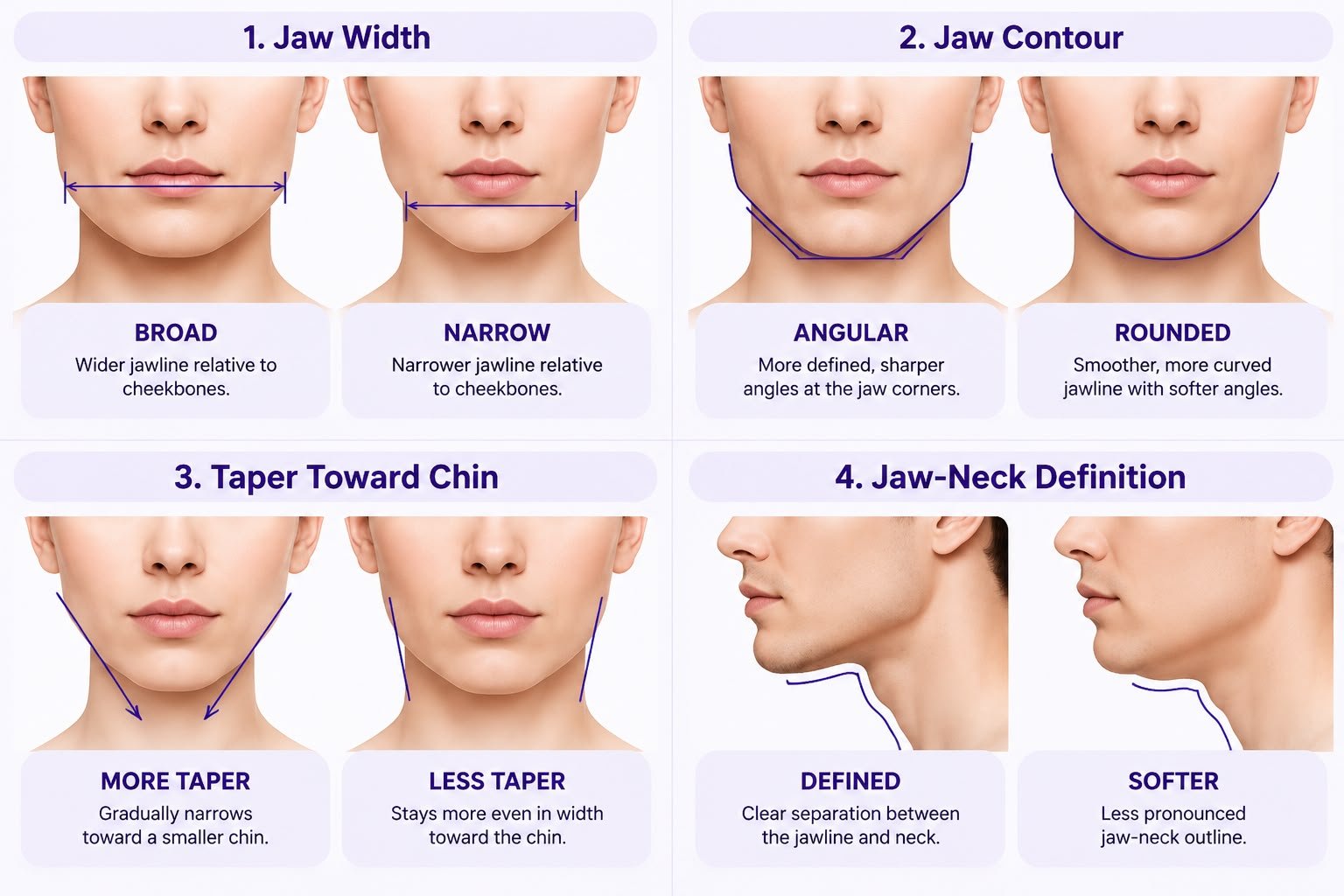
| Dimension | What to look at | Common confusion |
|---|---|---|
| Width | Compare jaw width to cheekbone width in a straight-on photo. Broad means the jaw is nearly as wide as the cheekbones; narrow means it sits well inside them. | "Square" is often used for broad jaws, but width alone doesn't tell you about the corners — a broad jaw can have soft, rounded corners. |
| Contour | Look at the jaw corners (below the ears). Angular means a visible corner or bend; rounded means a smooth, continuous curve into the chin. | Clenching can temporarily make the chewing muscles more prominent. Keep the jaw relaxed when comparing photos. |
| Taper | Follow the jaw from the corners toward the chin. More taper means a V-like narrowing; less taper means the width holds almost to the chin. | Taper is often confused with chin shape — a pointed chin with a wide jaw is a different combination than a narrow, tapered jaw. |
| Definition | Look at the edge between jaw and neck in even lighting. Defined means a crisp visible border; softer means the transition blurs, often due to soft tissue, posture or lighting. | Definition changes with head position — tilting the chin down compresses tissue and softens the outline without changing the bone. |
Overlap is normal. A jawline can be broad and soft-outlined, or narrow and angular. When online quizzes force you into one of eight boxes, they are flattening these overlapping features into a single label — useful as shorthand, but not anatomically precise.
Jawline Types vs. Face Shapes
Labels like heart and diamond describe overall face shape, not the jawline. A heart face shape means a wider forehead tapering to a narrower chin; a diamond face shape means narrow forehead and chin with wider cheekbones. Both describe the whole face, including regions far from the jaw.
This matters because:
- Two people with the same jawline can have different face shapes (different foreheads/cheekbones).
- Advice written for a "heart face shape" may be about balancing the forehead — irrelevant if you only wanted to understand your jaw.
- When a site lists "heart-shaped jawline" as a jawline type, it is borrowing a face-shape term. Treat it as loose language, not a technical category.
How to Identify Your Jawline in 3 Steps
- Take a neutral, evenly lit photo at eye level. Face the camera directly, relax your mouth (lips closed, teeth not clenched), and keep your head level — not tilted up or down. Front-facing daylight near a window works well.
- Observe width, corners and taper. Compare jaw width to cheekbone width. Note whether the corners below your ears look like a bend or a smooth curve. Follow the line toward your chin — does it narrow gradually or hold its width?
- Check the side profile separately. Take a true side photo (ear visible, nose in profile). Look at the jaw angle, chin projection and the line from chin to neck. Do not assign a definitive label from a single angled selfie — perspective distortion from close phone cameras changes all of these readings.
Why Your Jawline Can Look Different in Photos
Before concluding anything from one picture, know that these factors change how a jawline photographs:
- Lighting: Light direction changes shadows and can emphasize or obscure the jawline. Use consistent, even lighting when comparing photos.
- Camera distance: Very close photographs can alter apparent facial proportions through perspective. Place the camera farther away and crop if needed; keep the same distance and camera settings for comparisons. A tripod helps maintain position, but does not eliminate perspective effects by itself.
- Head position: chin tucked down compresses under-chin tissue; chin lifted stretches it.
- Expression: smiling engages cheek muscles and changes the lower-face outline; clenching bulges the masseters.
- Facial hair: beards and stubble redraw the visible jawline entirely.
For a fuller guide on getting consistent photos, see our photography tips for AI face analysis.
Is There a "Most Attractive" Jawline?
No single jawline should be presented as universally most attractive. In experiments by Rhodes and colleagues, increasing facial symmetry increased attractiveness ratings for the faces studied. That finding concerns facial symmetry; it does not establish a preferred jawline type or show that symmetry matters more than every other facial feature.
These results do not validate a jawline ranking or an automated beauty score. Group ratings cannot determine what every individual will find attractive. Preferences vary by culture, individual taste and context.
Can Your Jawline Change Naturally?
Briefly: the appearance of your jawline can change — through body-fat changes, reduced puffiness, posture, or muscle tone — but the underlying bone contour does not reshape from home routines in adulthood. We cover what the evidence actually says, method by method, in our companion guide on How to Change Face Shape Naturally.
Try the FaceAgeCalc attractiveness test →See how facial proportions read in a photo — alongside this guide.Frequently Asked Questions
How do I know my jawline type?
Take a neutral, evenly lit photo at eye level. Observe your jaw's width relative to your cheekbones, whether the corners look angular or rounded, and how the jaw tapers toward the chin. Check the side profile separately — one selfie angle is not enough for a definitive label.
Is jawline shape the same as face shape?
No. Jawline describes the lower-jaw contour only. Face shape classification also considers the forehead, cheekbones and overall proportions. Labels like heart or diamond are face-shape descriptions, not jawline types.
Can a jawline be both square and soft?
Yes. Width and contour are separate dimensions. A jaw can be relatively broad (square-ish width) while having a rounded, soft outline with no sharp corners. Online labels often mix these dimensions, which is why one person's jaw can match more than one description.
Is a double chin a jawline type?
No. A double chin describes soft tissue under the chin, not the bone contour of the jaw. Treating it as a jawline category is misleading because it can appear or disappear with weight, posture or camera angle while the underlying jaw structure stays the same.
Why does my jaw look different from the side?
The front view shows width and symmetry; the side profile shows projection, the jaw angle and chin position. These are different measurements, so a jaw that looks defined head-on can look softer in profile and vice versa. Lighting and head tilt change both views.
Can an AI tool identify my jawline accurately?
Some AI tools estimate facial landmarks or assign appearance labels from a photograph. Accuracy depends on the specific tool, its validation and the photo conditions. Treat a jawline label as an approximate description, not an anatomical measurement or diagnosis.