
For centuries, artists, portrait painters, and aesthetic analysts have analyzed the human face by breaking it down into horizontal sections to evaluate symmetry and balance. If you are curious about how to measure facial thirds, the underlying concept is straightforward: it involves dividing the frontal view of your face into three horizontal zones spanning from your hairline down to the bottom of your chin.
In classical portraiture and cosmetic evaluation, three equal zones serve as a traditional benchmark for balanced face proportions. However, having mathematically identical thirds is far from a universal standard or a strict requirement for beauty. Most individuals naturally display minor variations across their upper, middle, and lower regions.

Learning to measure your facial thirds offers an objective look into your structural framing. Rather than acting as a rigid beauty assessment, this guide provides a practical measuring framework to help you understand your unique proportions for personal styling, grooming, hair design, and aesthetic self-awareness.
The Three Zones, Defined
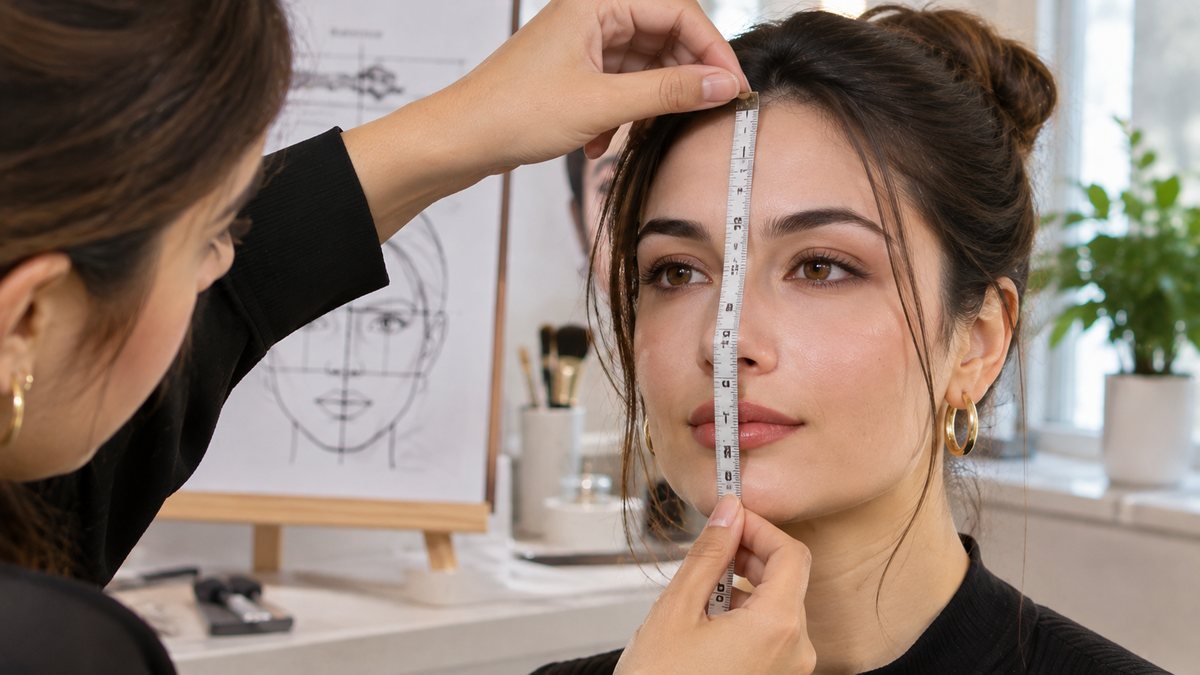
To evaluate your face accurately, you must first understand where each zone begins and ends. While aesthetic literature and clinical cephalometrics occasionally use different technical anatomical terms, standard facial analysis relies on four primary horizontal landmarks.
1. The Upper Third
The upper third occupies the top region of your face. It starts at the trichion—the natural hairline at the center of your forehead—and extends down to the glabella, which corresponds to the horizontal line running across your eyebrows (the eyebrow line or supraorbital ridge).
Note on variations: The upper third is the most variable zone because hairlines naturally differ. Male pattern baldness, a high forehead, a widow’s peak, or a low hairline will change the physical height of this segment. In clinical settings where hair pattern varies, practitioners sometimes measure from the highest forehead crease instead of the scalp line.
2. The Middle Third
The middle third covers the central structural features of your face. It begins at the eyebrow line (glabella) and extends downward to the subnasale—the point where the base of your nasal septum meets your upper lip.
This zone houses your eyes, cheekbones, and nose. Because it contains prominent bony structures that remain largely unchanged throughout adult life, the middle third frequently serves as an anchor point when comparing overall facial balance.
3. The Lower Third
The lower third encompasses the lower mouth, jaw, and chin frame. It starts at the base of the nose (subnasale) and ends at the menton, which is the lowest point on the soft tissue outline of your chin.
For more detailed aesthetic assessments, clinicians often subdivide the lower third into two smaller parts:
- Upper sub-zone: From the base of the nose to the border of the lips (accounting for roughly one-third of the lower zone height).
- Lower sub-zone: From the lower lip down to the bottom of the chin (accounting for roughly two-thirds of the lower zone height).
Honest analysis requires acknowledging that measuring points vary slightly depending on the field. Plastic surgeons, orthodontists, and makeup artists might adjust landmarks slightly—such as measuring from the center of the pupil or the brow crest. However, using the hairline, brow line, nose base, and chin tip offers the most practical, repeatable framework for home self-assessment.
How to Measure Your Facial Thirds: Two Methods
You do not need specialized clinical equipment to map your upper middle lower third face proportions. You can take accurate measurements using a physical tape measure in front of a mirror or by marking up a digital photo on your phone or computer.
Method A: The Mirror and Ruler Technique
This direct physical method requires a flexible tape measure or a straight ruler, a well-lit space, and a wall-mounted mirror.
- Adopt a neutral head position: Stand straight and look directly into the mirror. Keep your posture relaxed and your head level—neither tilting up toward the ceiling nor dipping down toward your chest. Keep your teeth gently together with your lips relaxed.
- Measure the Upper Third: Place the zero end of your ruler at the central hairline. Measure straight down vertically to the point directly between your eyebrows. Record this distance in millimeters or fractions of an inch.
- Measure the Middle Third: Place the ruler at the brow line and measure down to the precise spot beneath your nostrils where the nose connects to your upper lip. Record this number.
- Measure the Lower Third: Position the zero mark at the base of your nose and measure down to the lowest edge of your chin. Record this final number.
- Compare the numbers: Lay out all three numbers side-by-side to assess your horizontal distribution.
Method B: Digital Photo Analysis
Digital photo evaluation is often easier because it eliminates the awkwardness of holding a ruler against your face while keeping your head still.
- Take a neutral portrait: Have someone take a straight-on photo of your face, or set your camera at eye level on a tripod. Position yourself roughly 5 to 6 feet away and use a slight optical zoom to minimize perspective distortion. Avoid close-range hand-held selfies, which distort central facial features.
- Open the photo in a markup tool: Use any basic image editor, photo app, or drawing tool on your phone or computer.
- Draw four horizontal parallel lines:
- Line 1: Across the central hairline.
- Line 2: Across the upper border of the eyebrows.
- Line 3: Across the bottom base of the nose.
- Line 4: Across the bottom contour of the chin.
- Calculate pixel or unit height: Use your editor’s measurement tool, pixel counter, or a physical ruler placed against your screen to measure the vertical height between Line 1 and 2, Line 2 and 3, and Line 3 and 4.
What Counts as "Roughly Equal"?
When evaluating your findings, keep realistic expectations in mind. A mathematically perfect 1:1:1 ratio across all three zones is exceptionally rare in nature.
Small variances—such as a few millimeters of difference between zones—are standard across human populations. If your upper third measures 60mm, your middle third 64mm, and your lower third 61mm, your face is considered practically equal and visually balanced. You do not need absolute mathematical equality to possess a harmonious facial structure.
What Your Thirds Can Tell You

Understanding your face proportions thirds offers insight into how light, shade, and geometry shape visual perception. Different relative zone lengths subtly alter how your face reads to observers in person and on camera.
A Longer Lower Third
When the lower third is longer than the middle and upper zones, the face often projects a stronger, more pronounced jawline. In photographs, a longer lower third can make the overall facial structure appear longer or more mature. If the lower third is significantly longer, it may draw attention toward chin projection or vertical jaw height.
A Longer Middle Third
A prominent middle third is quite common. A longer central zone often corresponds to a longer nose bridge or high, extended cheekbones. Because central features anchor human visual recognition, a dominant middle third usually goes completely unnoticed in day-to-day interactions, simply contributing to an elongated, elegant facial profile.
A Shorter Upper Third
A shorter upper third typically reflects a naturally low hairline rather than a smaller underlying frontal bone structure. Conversely, a prominent or extended upper third usually points to a higher hairline or a broad, tall forehead.
Proportions and Overall Face Shape
Your horizontal thirds work hand-in-hand with your overall facial outline—whether your face is round, oval, square, heart-shaped, or oblong. For example, an oblong face often features both a long middle third and a long lower third, whereas a round face usually presents compact middle and lower zones.
If you want to see how your horizontal and vertical ratios interact with your overall perimeter structure, try our online face shape detector for a quick structural breakdown.
Can You Change Your Facial Thirds?
The short answer is: structurally, no; visually, yes.
In healthy adults, the underlying craniofacial bones are fixed. Short of undergoing invasive jaw surgery (orthognathic procedures) or plastic surgery procedures (such as hair transplant lines or chin re-contouring), your physical skeletal measurements remain set.
However, your perceived facial thirds can be dramatically altered through styling, grooming, and cosmetics. Visual proportion is heavily influenced by contrast, framing, and focal points.
Adjusting the Upper Third
- Hairstyles with Bangs: Adding a fringe or forehead-framing bangs visually conceals the upper boundary, effectively creating the optical illusion of a shorter upper third.
- Volume and Height: For individuals with a shorter upper third, sweeping the hair upward (such as with a pompadour or voluminous crop) draws the eye upward, expanding the perceived height of the upper face.
Adjusting the Middle Third
- Eyebrow Shaping: Adjusting where your eyebrows sit through grooming changes the boundary between the upper and middle thirds. A thicker, higher arch expands the middle zone, while a straighter, lower brow compresses it.
- Contouring and Blush: Applying contour diagonally beneath the cheekbones breaks up vertical height in the middle zone, creating an illusion of greater facial width rather than length.
Adjusting the Lower Third
- Beard Grooming: For men, facial hair is one of the most effective tools for rebalancing the lower third. A trimmed, short beard can reduce the visual length of a long chin, while a fuller, squared-off beard adds vertical length and density to a short lower third.
- Lip Color and Contouring: Strategic lip liner and makeup applications can subtly redefine the perceived distance between the nose base and the lower jawline.
Facial Thirds FAQs
Are everyone's facial thirds equal?
No. Perfect equality across all three horizontal zones is rare. Most people have naturally unequal facial thirds, with one zone being slightly longer or shorter than the others. Human faces naturally feature subtle asymmetries and proportion variances, which contribute to individual uniqueness rather than visual flaws.
Which third matters most for facial balance?
No single third takes priority over the others. Visual balance relies on how all three zones interlock with your facial width, feature distribution, and soft tissue volume. While the middle third anchors central eye contact, overall structural harmony depends on the relationship between all three sections combined.
Do facial thirds change with age?
Yes, the appearance of your facial thirds changes over time. While your underlying skeletal framework remains relatively stable during adulthood, aging causes changes in soft tissue, loss of facial fat pads, reduced skin elasticity, bone resorption, and shifting hairlines. Receding hairlines increase the visible size of the upper third, while soft tissue descent around the jaw and chin can alter the visual definition of the lower third.
Is the thirds rule the same as the golden ratio?
No, they are different systems. The facial thirds rule divides the face vertically into three equal horizontal bands using a simple 1:1:1 ratio. The golden ratio (often designated by the Greek letter Phi, roughly 1.618) evaluates mathematical relationships between various points across the face—such as the ratio of mouth width to nose width. Both are useful reference frameworks in art and aesthetics, but they utilize entirely different measuring systems.
Why does my selfie give different measurements than my ruler?
Front-facing smartphone camera lenses often have short focal lengths (typically equivalent to 24mm or 28mm). When held close to your face, these wide-angle lenses create perspective distortion—commonly called "lens distortion." This effect artificially enlarges central features (expanding the middle third) while causing the outer perimeters (upper forehead and lower chin) to slope away. To get accurate photo measurements, take a photo from at least 5 feet away using a telephoto lens or camera zoom, or stick to direct physical ruler measurements in front of a mirror. ---
Finding Harmony in Your Natural Proportions
Evaluating your facial thirds is an enlightening way to understand your natural geometry. Whether your facial structure aligns closely with the classic equal thirds baseline or features distinct structural variations, remember that geometric rules are reference guides, not beauty standards. Recognizing how your upper, middle, and lower zones interact equips you with practical insights for selecting flattering haircuts, beard styles, glasses, and makeup techniques that celebrate your unique facial structure.