
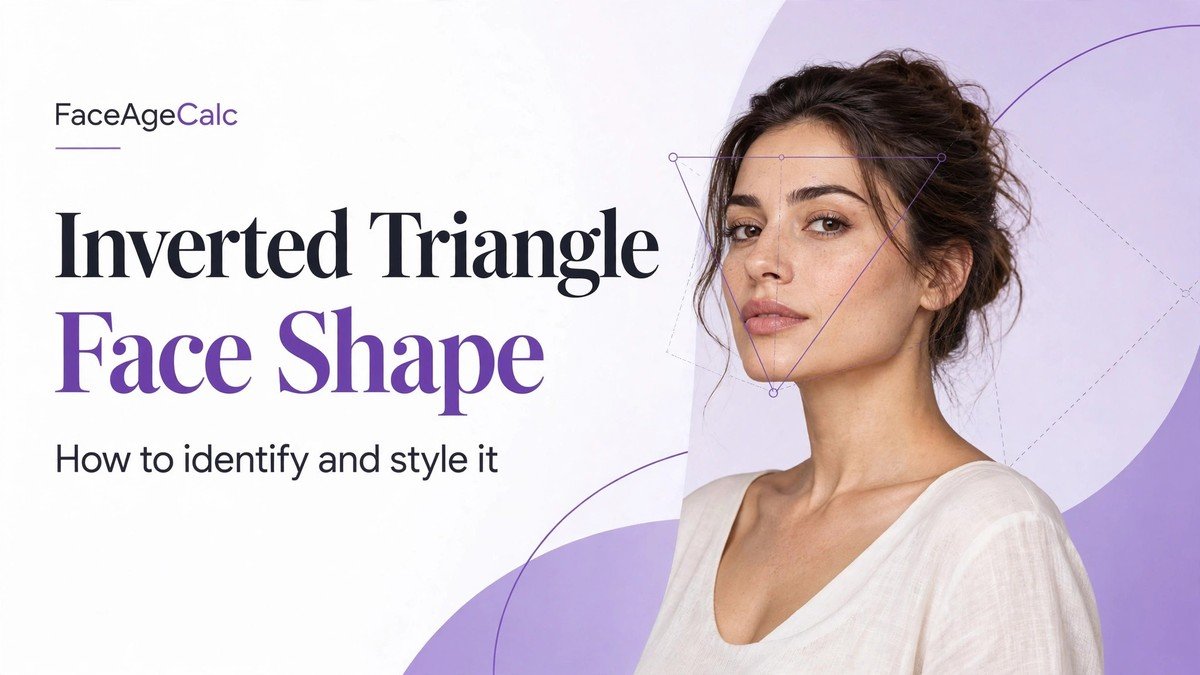
An inverted triangle face shape is commonly described as having a forehead that appears wider than the jaw, with the face narrowing toward the chin. If this sounds like your proportions, you can use the label to explore haircuts, fringe, partings, and other styling choices. It is not a rulebook: the right style depends on your hair, your preferences, and the features you want to emphasize.
Some styling guides use “heart-shaped” and “inverted triangle” almost interchangeably; others draw a distinction between them. This guide explains the overlap, shows how to compare similar outlines, and offers flexible options for short, medium, and long hair—without treating any feature as something that needs correcting.
What Is an Inverted Triangle Face Shape?
In face-shape styling guides, an inverted triangle generally has a wider upper face—often the forehead and temples—and a narrower jaw and chin. The outline tapers as it moves downward. Cheekbones may be close to the forehead in width, but the exact proportions vary from person to person.
The name describes a rough outline, not a medical or psychological category. There is no single universally applied measurement system for everyday hairstyle advice, and a person may share features with more than one shape. The label is useful only if it helps you find style ideas that suit the look you want.
A heart-shaped face is frequently described in similar terms. Inside Out Style’s heart-shaped face styling guide notes that a heart shape may or may not have a widow’s peak and may also be called an inverted triangle. Because terminology differs across guides, focus on the proportions you can actually see rather than worrying about the label.
For styling, one common approach is to experiment with softness around the forehead and visual fullness near the lower face. That may mean a side-swept fringe, a chin-length bob, or waves that begin around the jaw. You can also choose a slicked-back style, a short crop, or a dramatic high-volume look if that better expresses your taste. These are styling options, not requirements.
How to Check Your Face’s Overall Proportions
You do not need a precise measurement to make a useful first estimate. Start with a straight-on mirror view or a photo taken from a little distance, with the camera near eye level. Pull your hair away from the forehead so that the hairline and outer face outline are easier to see.
- Compare the forehead and jaw. Does the forehead or temple area look wider than the lower jaw?
- Look at the cheekbones. Are they close to the forehead in width, or do they appear to be the widest point of the face?
- Notice the chin. Does the face narrow gradually to a smaller chin, or is the jaw broader and more angular?
- Consider overall length. A long face can also be narrow, so note whether the face looks longer than it is wide.
- Check another view. A selfie taken too close can distort proportions. Hair covering the temples, a tilted head, strong shadows, and camera angle can all change the apparent outline.
Do not decide from one feature alone. A widow’s peak, for example, is a hairline pattern—not a required test for an inverted triangle or heart-shaped face. Likewise, a pointed chin by itself does not prove that the whole face belongs to one category.
If you remain between two labels, that is normal. You can borrow styling ideas from both categories and decide based on how a particular cut looks and feels on you. An online detector may offer an estimate from a photograph, but it cannot fully account for every angle, hairstyle, or personal preference.
Inverted Triangle vs Heart, Diamond, and Triangle
These names can be confusing because styling websites do not always use them consistently. The simplest way to compare them is to look at which part of the face appears widest and how the outline narrows toward the chin.
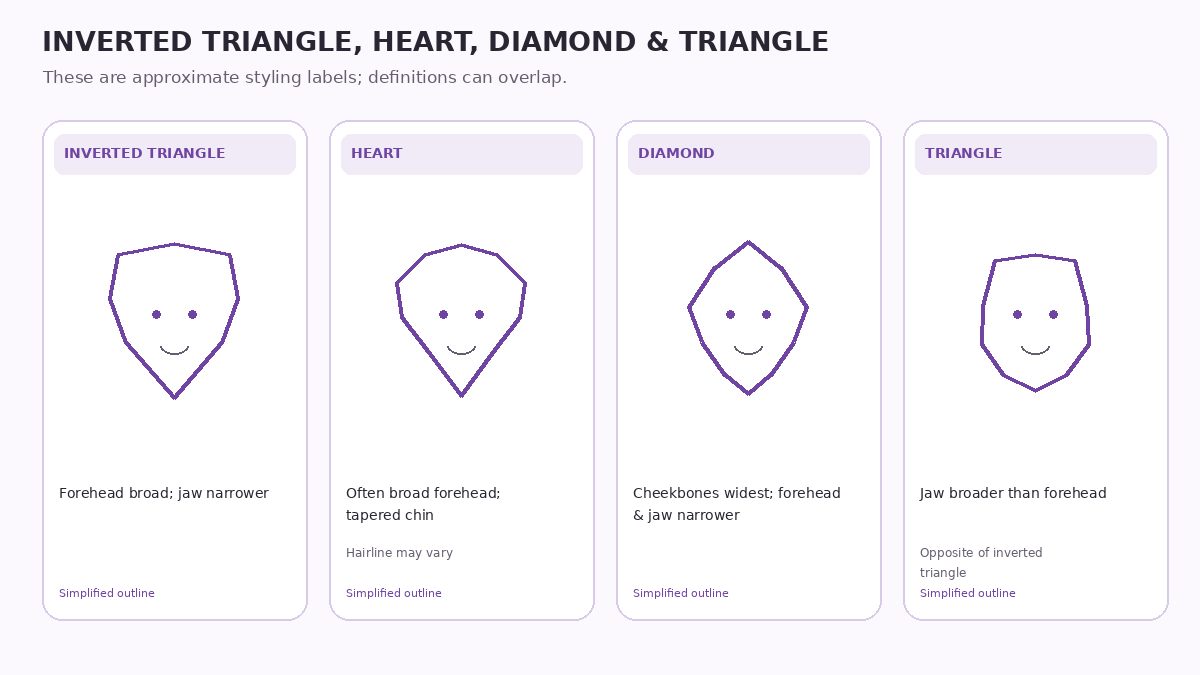
| Style label | Common description | What to compare |
|---|---|---|
| Inverted triangle | Forehead or upper face appears wider; jaw narrows toward the chin. | Compare the forehead and temple width with the jaw. |
| Heart | Often a broad upper face tapering to a narrower chin; the hairline may vary. | Guides overlap with inverted triangle; do not rely on a widow’s peak alone. |
| Diamond | Cheekbones appear widest, with a narrower forehead and jaw. | Check whether the cheekbones, rather than forehead, are the widest area. |
| Triangle | Jaw appears wider than the forehead—the opposite direction from inverted triangle. | Compare the width of the lower jaw with the upper face. |
For more context on partings and how they change the visible frame, Byrdie’s stylist-informed guide to hair partings by face shape provides examples across several common categories. Treat those suggestions as professional styling perspectives, not strict anatomical rules.
If your forehead and cheekbones look similar in width but your jaw is narrower, you may find advice written for both heart and inverted-triangle shapes useful. If the cheekbones stand out as the widest point, diamond-shape examples may be more relevant. If the jaw is the widest part, look at triangle-shape advice instead.
Short Haircut Ideas
Short hair can work with an inverted-triangle outline. The most useful details to consider are where the cut keeps fullness, how the fringe sits, and whether the sides are close-cropped or left softer. Choose based on the look you want rather than assuming a particular length is off-limits.
Pixie cuts and textured crops
A pixie can be cropped close or leave more length around the fringe and temples. If you want to soften the upper outline, discuss a side-swept or textured front rather than automatically adding height at the crown. A textured crop can also work with straight, wavy, curly, or coily hair when the stylist adapts the length and shape to your natural pattern.
Short bob
A bob that ends around the jaw can create movement or fullness near the lower face, especially if the ends are shaped to sit away from the neck. A blunt bob gives a clearer perimeter; a softly layered or wavy bob has more movement. Ask the stylist where the bottom edge will land when your hair is dry, particularly if you have curls or a strong wave pattern.
Short cuts for men
A textured crop, a side-swept fringe, or a scissor cut with some length around the temples are options to discuss. If you prefer a fade, you do not need to avoid one entirely; consider how high the fade sits and whether the overall top shape adds more width or height than you want. Beard styling can also affect the lower outline, but it is optional and should reflect your personal preference.
When choosing a short style, think about how much styling you want to do. A highly textured crop may need product to hold separation, while a simple scissor cut may be easier to wear with minimal effort. Ask the stylist to show you how the shape will sit on a normal day, not only after a salon finish.
Medium and Long Haircut Ideas
Medium and long styles offer more opportunities to place movement around the cheekbones, jaw, and shoulders. If you want to add visual fullness lower down, discuss where the layers begin and where the ends sit. You do not have to follow this direction if you prefer a sleek or elongated silhouette.
Lob and collarbone-length cuts
A long bob (lob) that sits near the collarbone can be worn blunt, softly layered, or with waves through the lower lengths. If you want more fullness around the jaw, ask whether layers beginning at or below that point will work with your hair density. A one-length perimeter can preserve weight, while too many layers may leave some hair types looking lighter at the ends.
Layers and face-framing pieces
Face-framing layers can begin around the cheekbones, jaw, or collarbone. For an inverted-triangle outline, you might try layers that bring movement toward the lower half of the face. The right starting point depends on hair length, texture, and how the layers blend into the rest of the cut. Ask to see where the shortest pieces will fall before committing.
Waves and curls
Waves and curls can add natural movement, especially through the lower lengths. You might try a layered cut that keeps enough body around the jaw or shoulders. If your hair is curly or coily, remember that dry length can look shorter than wet length because curls spring up; discuss how the stylist plans to cut and shape your hair.
Long hair and tied-back styles
Long hair can be worn straight, wavy, curly, or in a ponytail or updo. A centre part, side part, or a few loose front pieces can change how much of the forehead is visible. A sleek pulled-back style can deliberately emphasize the upper face; there is no need to avoid it if you enjoy that effect. For a softer frame, you can leave face-framing pieces or try a fringe that works with your hairline.
Glasses, Beards, and Optional Makeup Choices
Hair is only one part of personal styling. Glasses, facial hair, accessories, and makeup can change the overall impression, but none is required to make an inverted-triangle face look “better.” Use these ideas only if they fit your preferences and comfort.
Glasses
When choosing glasses, start with fit, comfort, prescription needs, and the proportions of the frame. You may enjoy frames with softer curves or visual detail toward the lower rim, but face-shape rules are only a starting point. Try several shapes in person if possible, and choose the pair you like wearing.
Beard and facial hair
If you wear a beard, its outline can change the apparent width of the jaw and chin. A little more fullness along the jaw or chin may create a different silhouette from a tightly cropped beard. Ask a barber to show you options based on your growth pattern and maintenance preference; there is no need to grow facial hair solely to match a face-shape guide.
Makeup and accessories
Makeup techniques such as blush placement or contouring can alter the appearance of shadows and emphasis, while earrings and other accessories can draw attention to different areas. These are optional creative tools, not corrections. If you prefer a natural look, you can skip them entirely.
Common Identification and Styling Mistakes
The most common mistake is treating a face-shape label as a fixed identity and then following every recommendation literally. Face-shape advice is broad; real faces have mixed proportions, and the same haircut behaves differently depending on hair texture, density, growth patterns, and styling technique.
- Using one feature as a test. A widow’s peak, pointed chin, or broad forehead alone cannot classify the whole face.
- Confusing triangle with inverted triangle. These terms describe opposite width patterns in common styling usage. Check whether the forehead or jaw is wider.
- Assuming all guides agree. Heart and inverted triangle overlap in many resources, while others describe them separately. Focus on visible proportions and useful style ideas.
- Choosing a cut from a filtered photo. Angles, lighting, extensions, and styling products can change the apparent outline. Look for multiple references where possible.
- Ignoring your natural hair. A haircut that looks good when professionally blow-dried may be difficult to maintain if you air-dry or have a different texture.
- Believing a feature needs correction. A broad forehead or narrow chin is simply part of your appearance. A haircut can highlight, soften, or leave those features visible depending on what you prefer.
When you are uncertain, take two or three photos of styles you like and note the exact detail that attracts you. This turns an abstract label into a practical conversation with your stylist.
Frequently Asked Questions
Is an inverted triangle face the same as a heart-shaped face?
Many styling guides use the terms interchangeably because both commonly describe a wider upper face narrowing toward the chin. Other guides make a distinction, so terminology is not consistent. Compare your forehead, cheekbones, jaw and chin, then use whichever set of styling ideas is useful.
Does a heart-shaped face require a widow’s peak?
No. A widow’s peak is a hairline feature, not a requirement for a heart-shaped or inverted-triangle outline. Consider the overall proportions rather than classifying a face from one hairline detail.
How is an inverted triangle different from a diamond face?
In common styling descriptions, an inverted triangle is widest across the forehead or upper face, while a diamond shape is widest at the cheekbones, with a narrower forehead and jaw. These are approximate labels, and mixed proportions are common.
Can an inverted triangle face suit short hair?
Yes. Pixies, textured crops, and short bobs are all options to explore. The fringe, side length, and placement of volume can change the result, so ask your stylist to adapt the cut to your hair texture and preferred styling routine.
Which fringe styles can I discuss with my stylist?
Side-swept fringe, curtain bangs, wispy bangs, or a longer textured fringe are possible starting points. Consider your hairline, cowlicks, texture, and daily styling time. No single fringe is required for a particular face shape.
Can I have features of more than one face shape?
Yes. Face-shape categories are broad styling descriptions rather than rigid boxes. Your forehead, cheekbones, jaw, and overall length may not fit one label exactly. You can combine ideas from different guides and choose what feels right to you.