
Having a round face shape means your facial structure is defined by soft, continuous curves, smooth lines, and balanced proportions. People with round faces typically have a face width and face length that are nearly identical, creating a harmonious and symmetry-focused silhouette. Rather than sharp angles or a prominent, squared jawline, the overall boundary of the face forms a gentle circle or soft arc.
One of the most defining characteristics of a round face is that the cheekbones form the widest point of the face. The forehead and jawline taper slightly inward from the cheeks, but they do so with rounded edges rather than sharp corners. The chin is typically soft and curved, completing an overall perimeter that lacks harsh angles or abrupt directional changes.
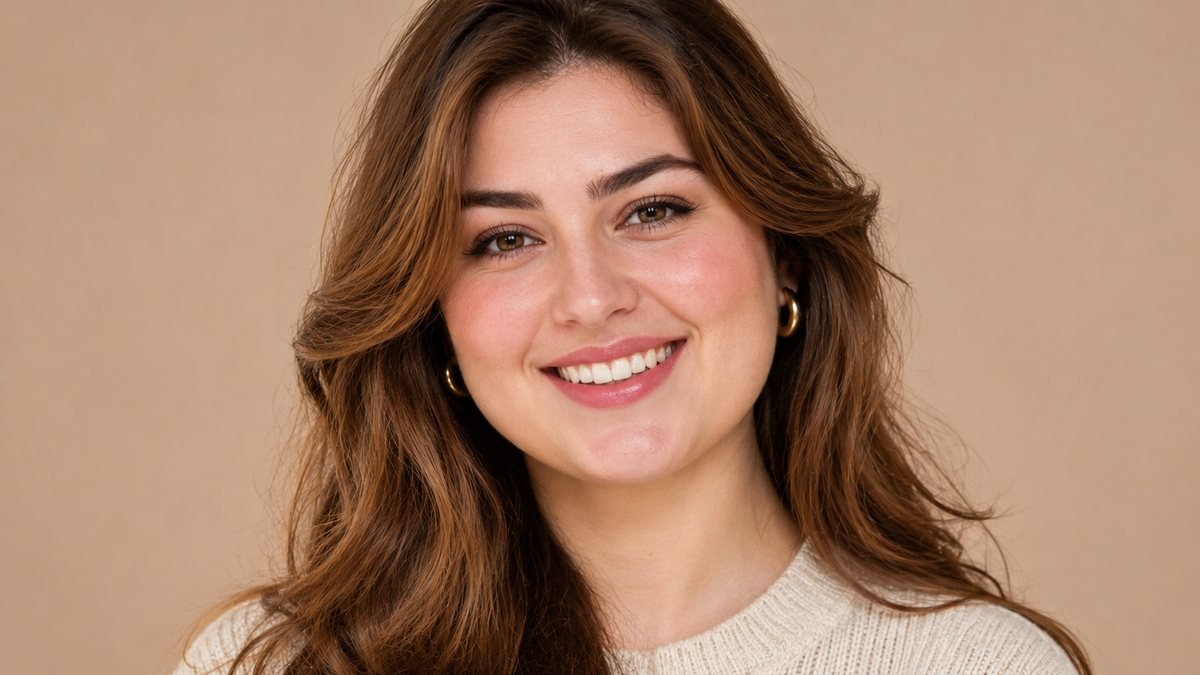
It is essential to understand that a round face shape is strictly a matter of bone structure and anatomical proportions, not body weight. Anyone at any body size can have a round face shape. Bone length, cheekbone prominence, and jaw structure dictate your silhouette, which means a naturally round facial frame remains constant regardless of weight changes.
How to Tell if You Have a Round Face Shape
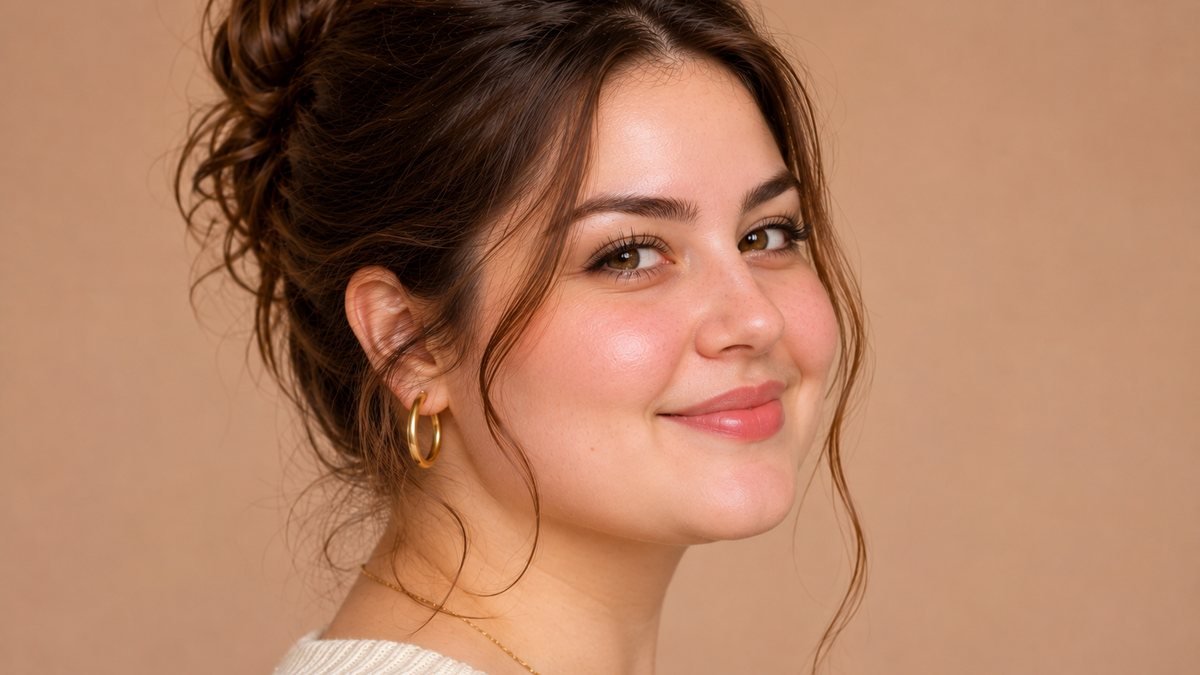
Determining whether you have a round shaped face comes down to examining a few structural markers. While every individual’s face is unique, a truly round face usually exhibits the following key characteristics:
- Equal Length and Width: The distance from your upper forehead (at the hairline) to the tip of your chin is roughly equal to the distance across your face from cheekbone to cheekbone.
- Cheekbones Are the Widest Point: Your cheekbones form the widest span across your face. Unlike heart or diamond shapes where the forehead or cheekbones dominate dramatically over a narrow chin, a round face maintains a smooth taper upward to the forehead and downward to the jaw.
- Soft, Rounded Jawline: Your jawline curves gently from the bottom of your ears down to your chin without defined corners, sharp turns, or broad boxy edges.
- Rounded Chin: The chin lacks a sharp point or flat, squared edge. Instead, it curves smoothly along the bottom perimeter of your face.
- Absence of Sharp Angles: There are few distinct focal angles on the face. The hairline, cheek outline, and jawline transition into one another seamlessly.
If these traits describe your mirror reflection, your underlying facial geometry falls into the round category.
Round vs Oval vs Square Face Shapes
It can sometimes be challenging to distinguish a round face shape from nearby shapes like oval or square. While all three share certain balanced characteristics, their specific ratios and edge definition set them apart.
| Face Shape | Length vs. Width Ratio | Widest Point | Jawline Character | Chin Shape |
|---|---|---|---|---|
| Round | Nearly equal (1:1 ratio) | Cheekbones | Soft, rounded, smooth curve | Softly rounded |
| Oval | Longer than wide (approx. 1.5:1 ratio) | Cheekbones | Soft, gently tapering curve | Softly rounded / oval |
| Square | Nearly equal (1:1 ratio) | Forehead, cheeks, and jaw equal | Sharp, angular, wide corners | Flat or squared |
When evaluating a round vs oval face shape, the main difference lies in vertical length. Both shapes feature soft, rounded boundaries without sharp jaw angles, but an oval face is noticeably longer than it is wide. A round face, by contrast, maintains an almost equal measure horizontally and vertically.
When comparing a round face to a square face, the width-to-length ratio is similar, but the difference comes down to angles. A square face features a strong, angular jawline with clear corners and a broad, straight forehead. A round face replaces those structural corners with smooth, sweeping curves.
Round Face Shape or Just Full Cheeks?

A common point of confusion when identifying face shape is distinguishing between a structural round face shape and temporary facial fullness. It is completely normal for facial features to change appearance based on factors like fluid retention, age-related tissue shifts, muscle mass, or body weight changes. However, these factors influence soft tissue, whereas face shape is defined by your underlying bone structure.
When analyzing a round face vs chubby face, remember that soft tissue volume on the cheeks does not automatically make a face shape round. A person with high cheekbones, a sharp angular jaw, and a pointed chin may carry full tissue over their cheeks while retaining a distinctly heart-shaped or diamond-shaped bone structure. Conversely, a very lean individual can have a classic round face shape if their facial skeleton features equal width and length paired with a soft, curved jaw.
To determine your true face shape, look past tissue softness and focus on your structural boundaries:
- The Jawline Base: Touch your jawline. Do your jaw bones form a prominent corner beneath your ears, or do they curve smoothly toward the chin?
- The Proportions: Is the vertical distance between your hairline and chin close to the horizontal distance across your cheekbones?
- The Hairline: Is your upper hairline curved and smooth rather than straight and broad?
Focusing on these structural indicators helps you accurately identify your facial framework independent of body weight or soft tissue variations.
How to Measure Your Face Shape at Home
To confirm your face shape with objective data, you can take four simple measurements at home using a flexible measuring tape. Stand in front of a mirror, keep your face relaxed, and record the following distances:
- Face Length: Measure from the center of your upper hairline straight down to the lowest point of your chin.
- Forehead Width: Measure across the widest part of your forehead, usually halfway between your eyebrows and your upper hairline.
- Cheekbone Width: Measure across your face from the outer corner of one cheekbone (just past the outer corner of your eye) to the outer corner of the opposite cheekbone.
- Jawline Width: Measure from the base of your jaw beneath one ear along the bone curve to the center of your chin. Multiply this number by two to get your total jawline width.
Analyzing Your Numbers
- Round Profile: Your Face Length and Cheekbone Width will be within a small fraction of an inch of each other. Additionally, your Forehead Width and Jawline Width will be smaller than your Cheekbone Width, but similar to each other, with all transitions feeling smooth and gradual.
- Oval Profile: Face Length will be noticeably larger (often 25–50% larger) than Cheekbone Width.
- Square Profile: All four measurements will be relatively close, but Jawline Width will feature prominent angular corners.
If you prefer an automated estimate without pulling out a tape measure, you can analyze your proportions using a photo with the face shape detector at FaceAgeCalc. This tool analyzes your facial geometry from a photo to help you confirm your shape within seconds.
Hairstyles That Suit a Round Face Shape
The primary objective when styling round face shape hairstyles is to add vertical optical length, create gentle height at the crown, or introduce diagonal lines that complement soft features. The best cuts elongate your silhouette while breaking up symmetry.
1. Long Layers Starting Below the Chin
Long, flowing hair that extends past the shoulders naturally draws the eye downward, creating an lengthening effect. Adding layers that begin below the chin prevents adding width around the cheeks while allowing natural movement along your shoulders.
2. Side-Swept Fringe / Curtain Bangs
A sweeping side fringe breaks up the circular outline of the forehead by introducing diagonal lines across the face. Similarly, curtain bangs that split near the center and fall past the cheekbones help frame the face vertically.
3. Height at the Crown
Adding volume at the top of the head—whether through subtle layering, teasing, or a textured cut—visually adds height to your face. This adjusts your overall head proportions to look slightly longer and more oval.
4. High Ponytails and Top Knots
Pulling your hair up into a sleek or textured high ponytail pulls the visual focus upward. Leaving a few loose, face-framing strands around the temples creates flattering vertical framing along the sides of the face.
5. Textured Pixie Cut with Top Volume
Short hair works wonderfully on a round face shape when cut with the right proportions. A pixie cut with closely cropped sides and textured volume on top adds height and structural interest without adding bulk to the sides of your face.
6. Deep Side Part
A deep side part breaks symmetry by shifting the eye's focus diagonally across the face. This simple styling change instantly makes a round face look longer and more structured.
Styles to Approach with Caution
- Chin-Length Blunt Bobs: A sharp, horizontal bob cut that ends exactly at the chin line draws a horizontal boundary right across the widest part of your face, emphasizing width.
- Full, Heavy Straight-Across Bangs: Thick horizontal bangs cut off the forehead, making the face look shorter and wider.
- Center Parts with Cheek-Level Volume: A middle part that features curls or volume concentrated directly next to the cheeks adds extra width where your face is naturally at its widest.
Glasses and Sunglasses for a Round Face Shape
When selecting eyewear for a round face shape, contrast is your best design tool. Geometric frames with defined angles add visual structure to soft facial contours, helping to balance your natural curves.
Frame Shapes That Work Best
- Rectangular Frames: Sharp horizontal lines break up facial roundness and make the face appear longer and thinner. Wide rectangular frames add crisp structure to soft cheekbones.
- Square Frames: Square frames introduce distinct right angles, providing a clean geometric contrast to a rounded chin and smooth jawline.
- Cat-Eye Frames: Frames that sweep upward at the outer corners draw the eye toward the temples, lifting your facial features visually.
- Browline / Clubmaster Frames: Eyewear with a bold, strong upper frame line emphasizes the brow line, adding structure to the top portion of the face.
Frame Features to Avoid
- Small, Perfectly Circular Frames: Round frames mimic your natural facial proportions, reinforcing the circular shape rather than balancing it.
- Undersized Frames: Eyewear that is too narrow for your face makes cheekbones appear wider by comparison. Choose frames that are equal to or slightly wider than the broadest part of your face.
Makeup Tips for a Round Face Shape
Makeup application for a round face shape focuses on creating subtle shadow definition along the sides of the face while bringing light to the central vertical axis.
1. Strategic Contouring Along the Outer Perimeter
To create subtle angular definition, apply a cool-toned contour shade along the sides of your face:
- Temples and Forehead: Apply contour lightly at the outer temples to narrow the upper face slightly.
- Under the Cheekbones: Start near the ear and blend contour inward along the hollow of the cheek, stopping beneath the outer corner of the eye. Blend thoroughly to create a soft, upward diagonal shadow.
- Jawline Edge: Lightly dust contour along the lower edge of the jawline to add subtle shadow definition under the chin.
2. Vertical Highlighting
To draw focus inward and elongate your face, keep your highlighter concentrated along the center vertical line:
- Apply highlighter to the center of your forehead.
- Sweep it down the bridge of your nose.
- Add a subtle touch to the Cupid's bow and the center of your chin.
3. Upward Blush Placement
Avoid placing blush in dark, concentrated circles directly on the front "apples" of your cheeks, as this emphasizes facial roundness. Instead, apply blush slightly above the apples of your cheeks and sweep it diagonally upward and back toward your hairline and temples.
4. Defined, Structured Eyebrows
Eyebrows act as a visual frame for your entire face. High, structured arches create vertical length and add sharp lines above your eyes. Avoid flat or completely rounded brow shapes, which echo the face's natural curves.
Famous Faces with a Round Face Shape
If you have a round face shape, you share your natural proportions with many well-known public figures. Stylists frequently work with these celebrities to highlight their classic features using smart haircuts, frame selections, and makeup techniques:
- Selena Gomez: Widely cited by hair and makeup artists as a classic example of a round face shape, featuring full cheekbones, balanced length and width, and soft, curved proportions.
- Kirsten Dunst: Frequently highlighted for her soft jawline, gentle chin, and beautifully balanced face proportions that suit long layered styles and deep side parts.
- Ginnifer Goodwin: Known for demonstrating how short hairstyles—like textured pixie cuts with top volume—look stylish and flattering on a round face shape.
- Chrissy Teigen: A great example of how radiant, full cheekbones pair with a soft jawline, often styled with curtain bangs and long wave textures to elongate her silhouette.
Round Face Shape FAQs
Can a round face shape become oval with weight loss?
Your core face shape is determined by bone structure, which does not change with weight loss. However, losing weight can reduce soft tissue volume around the cheeks and jawline, making underlying angles and cheekbones more visible. This can alter how your proportions look, but your fundamental facial skeleton remains the same.
Round or oval — how do I tell the difference?
The simplest way to tell them apart is by comparing length to width. Measure across your cheekbones and from your hairline to your chin. If the two measurements are nearly identical, your face shape is round. If your face length is noticeably longer than its width (by roughly 1.5 times), your face shape is oval.
Do round faces look younger?
A round face shape is often associated with a youthful appearance. This is because soft facial curves, full cheekbones, and a smooth jawline are naturally linked with youthfulness in human visual perception. While face shape is just one aspect of overall appearance, these features can help maintain a youthful look as you age.
What hairstyle should a round face avoid?
It is generally best to avoid chin-length, blunt-cut bobs with no layering, as well as thick, heavy straight-across bangs. These styles create bold horizontal lines right across the widest parts of your face, making your silhouette look shorter and wider than it actually is.
Is my face round or just chubby?
A face is structurally round if its length and width are nearly equal and the jawline curves smoothly at a skeletal level. "Chubby" refers to temporary soft tissue or fat distribution on the cheeks, which can occur on any facial bone structure—including square, oval, or heart shapes. Check your jaw bone corners and overall height-to-width ratio to find your true structural shape. ---
Final Thoughts
A round face shape is a balanced canvas defined by soft curves, symmetry, and full cheekbones. Whether you choose long layers that elongate your silhouette, geometric glasses that add structure, or vertical makeup highlights, the key to great styling is working with your natural symmetry.
If you want an easy way to check your facial proportions, upload a quick photo to the face shape detector at FaceAgeCalc to discover your unique geometry today.