
The phrase types of head shapes can mean different things in different contexts. In everyday styling, people may mean the visible outline of the face or how the head looks with a particular haircut. In anatomy and clinical settings, head-shape terms can refer to skull proportions or to a specific concern that needs professional assessment. These meanings should not be mixed together.
This guide explains the difference between head shape and face shape, introduces common descriptive terms, and shows what a cephalic index can—and cannot—tell you. It also separates general adult terminology from infant head-shape concerns, where a healthcare professional may need to assess development.
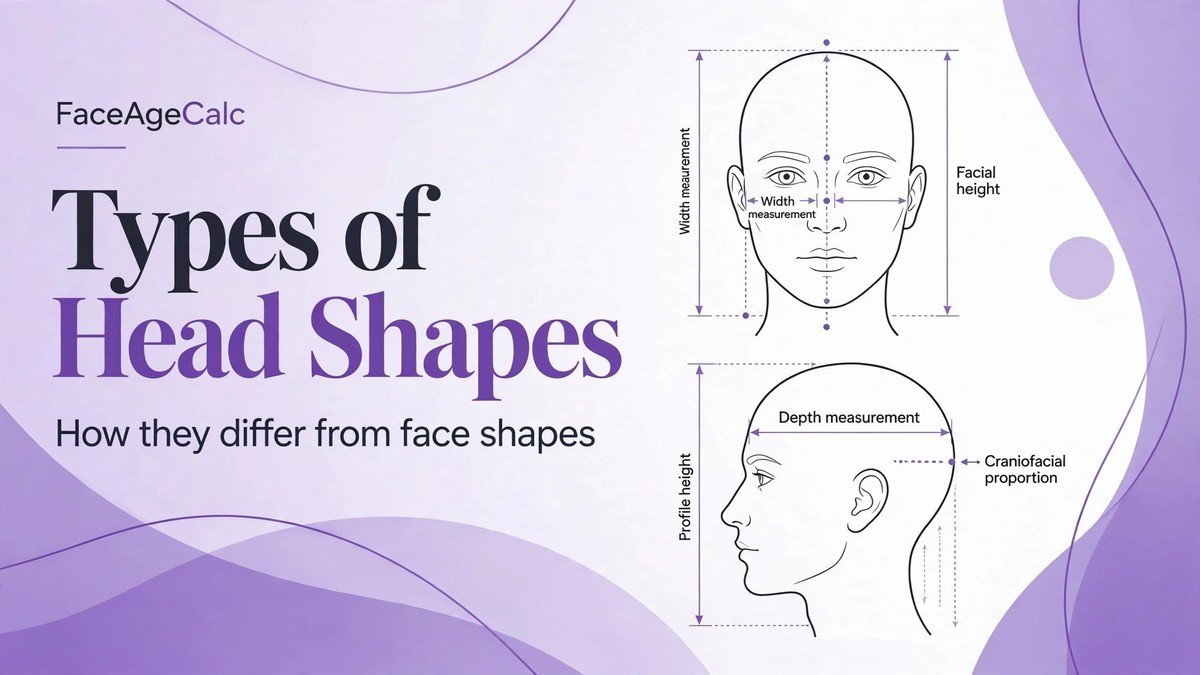
Head Shape and Face Shape Are Different
Face shape usually describes the visible outline from the forehead and cheekbones down to the jaw and chin. Common styling labels include oval, round, square, oblong, heart, diamond and triangle. People often use these categories to discuss haircuts, glasses, facial hair and makeup.
Head shape refers more broadly to the proportions and contour of the head, including the skull beneath the hair and the shape visible from front, side or above. Hair volume, a fringe, a close crop, camera angle and posture can change the apparent silhouette without changing the skull itself.
This distinction matters because a face-shape guide is not a clinical assessment of the skull. A selfie taken from the front may show the face outline, but it cannot reliably reveal the top or back of the head, the underlying bone contour, or the dimensions needed for a formal measurement. If your goal is a haircut, a stylist can help discuss the visible outline. If your concern is a new or unusual head shape, especially in a baby, seek appropriate healthcare advice instead of relying on an online label.
In scientific literature, head and facial features are described using standardized anatomical terms. The paper Elements of Morphology: Standard Terminology for the Head and Face discusses consistent terminology for describing features. Such terminology is more precise than informal styling labels, but it does not mean that every visible variation indicates a medical problem.
Common Terms for Head Proportions
Three traditional terms sometimes used to describe head proportions are dolichocephalic, mesocephalic, and brachycephalic. They refer broadly to a relatively longer, intermediate, or relatively broader head shape, respectively, in certain anthropometric systems. They are descriptive terms—not beauty categories and not, by themselves, diagnoses.
- Dolichocephalic: describes a head that is relatively long in relation to its breadth in the measurement system being used.
- Mesocephalic: describes proportions around the intermediate range in that system.
- Brachycephalic: describes a head that is relatively broad in relation to its length in that system.
The terms are based on proportions rather than a simple visual impression. Their interpretation depends on the measurement method, age, population reference and purpose of the assessment. Do not apply a category to yourself or a child based on a mirror view or a single photograph.
It is also important not to confuse a descriptive word with a medical diagnosis. In infant medicine, clinicians may discuss particular head shapes or conditions when assessing growth and skull development. The everyday use of “long head” or “broad head” is not enough to establish whether a condition is present.
What Is the Cephalic Index?
The cephalic index is a ratio used in some anthropometric contexts to compare maximum head breadth with maximum head length. In simplified form, it is calculated as:
Cephalic index = (maximum head breadth ÷ maximum head length) × 100
The breadth and length must be measured using a defined method. A casual measurement with a tape, a phone app or a selfie is not necessarily equivalent to a standardized anthropometric measurement. The result is meaningful only when interpreted within the relevant method and reference data.
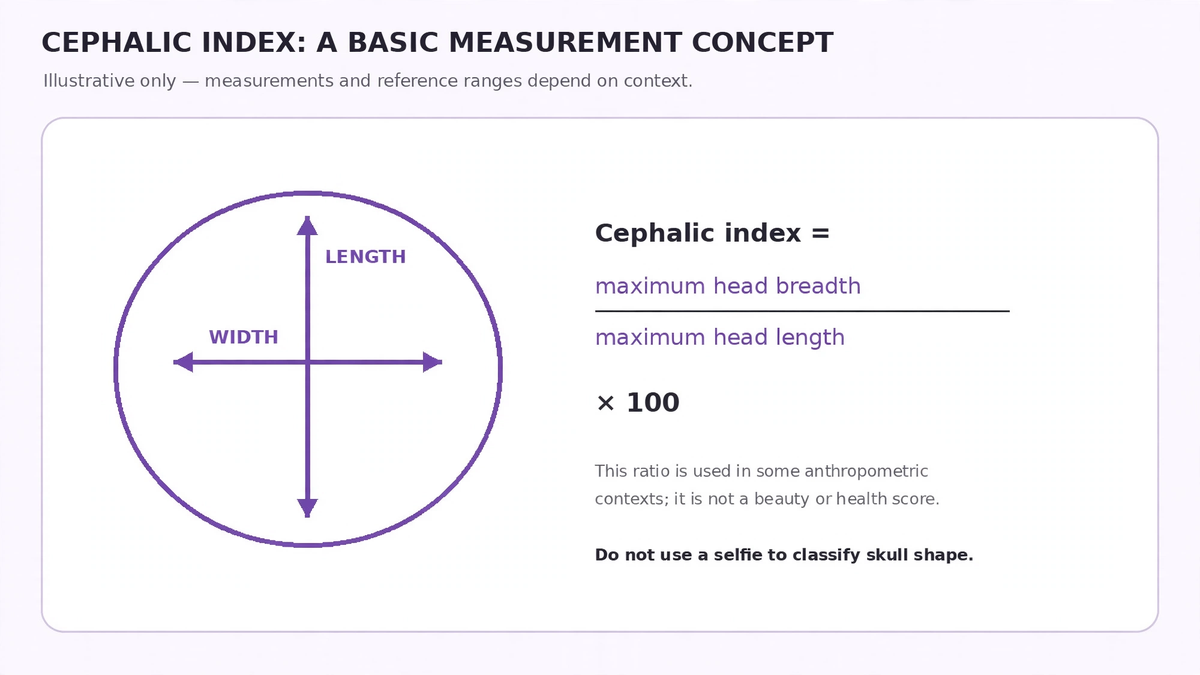
Researchers and clinicians may use head measurements for different purposes, such as describing population variation or monitoring development. The appropriate reference values can depend on age, population, sex, measurement protocol and the reason for measurement. A single universal threshold should not be assumed to apply to every person.
The cephalic index is not a beauty score, a measure of intelligence, or a stand-alone test of health. It also does not determine which haircut, glasses or hairstyle someone should choose. For styling, visible preferences and a professional consultation are more relevant than trying to calculate a skull ratio.
Why a Single Measurement Does Not Tell the Whole Story
Head measurements can look objective because they produce a number, but the number depends on how and why the measurement was taken. Different protocols may define landmarks or positioning differently. Comparisons can also be misleading when a measurement is interpreted using a reference group that does not match the person being assessed.
- Measurement technique: the measurement points and positioning must be consistent for results to be comparable.
- Age and development: head proportions change as children grow, so adult references should not be applied to infants.
- Reference population: published ranges may be based on specific populations or samples and may not generalize universally.
- Purpose: a research description, a growth assessment and a styling conversation are different tasks and require different kinds of evidence.
- Clinical context: a clinician considers growth over time, medical history, physical examination and other relevant findings rather than relying on one ratio alone.
Research has discussed the importance of reference data and the limits of treating cephalic-index categories as universal. For example, the scientific literature on cranial measurements emphasizes the need to consider population-specific norms and methodological differences. That is why a number found on a general website should not be treated as a personal diagnosis.
Why a Selfie Cannot Reliably Classify Your Skull
A photograph is a two-dimensional view of a three-dimensional head. A front-facing image may help you notice the outline of your face, but it does not show all the contours needed to describe the skull. Even side-view photos can be affected by lens distortion, head tilt, distance, hair coverage and camera height.
Photo-based face-shape detectors are designed to estimate visible facial proportions. They are not the same as a clinical tool for measuring the skull. Hair can hide the temples and forehead; volume can change the apparent width; and a close camera can make central facial features appear larger relative to the sides.
If you are choosing a haircut, use photos as references for the style rather than as proof of a skull category. If you are worried about a persistent or new change in head shape, a healthcare professional can determine whether examination or measurement is appropriate. For an infant, do not wait for an online tool to settle a concern about growth or skull development.
Infant Head Shapes: A Separate Medical Context
Infant head shape needs different consideration from adult styling categories. A baby’s skull is still developing, and some flattening can be associated with external pressure on the head. Other causes, including craniosynostosis—a condition involving early fusion of one or more skull sutures—require medical assessment. These conditions cannot be reliably distinguished through a general hairstyle or face-shape article.
The Cleveland Clinic’s overview of flat-head syndrome (plagiocephaly) explains one cause of infant head flattening and discusses clinical evaluation. That information applies to the infant context; it should not be generalized into advice about adult skull shape.
Parents and caregivers should speak with a pediatrician or other qualified healthcare professional if they notice persistent flattening, an unusual head shape, a change in head growth, or concerns about a baby’s development. Seek advice promptly if the shape seems to be changing or if a clinician has already raised a concern. The clinician can assess the head, review growth over time, and decide whether further evaluation is needed.
This article is for general information and does not replace medical advice. Do not try to diagnose craniosynostosis or another condition by comparing a baby’s photo with online diagrams. Do not use a cosmetic measurement or face-shape detector as a substitute for pediatric assessment.
When to Ask a Healthcare Professional
For adults, natural differences in head proportions are often simply variation. If your question is about how a haircut looks, a barber or stylist can help with the visible silhouette. If you have a new, unexplained change in head shape, a recent injury, pain, swelling, or another symptom, seek advice from an appropriate healthcare professional rather than treating it as a styling issue.
For babies and children, ask a pediatric healthcare professional when you notice persistent flattening, an unusual shape, asymmetry that concerns you, or a change in head growth. A clinician may consider the child’s age, birth and medical history, head-growth measurements, physical examination and developmental progress. The appropriate next step depends on the individual child.
When preparing for an appointment, it can help to note when you first noticed the concern, whether it has changed, and whether you have observed other symptoms. Bring questions rather than a self-assigned diagnosis. A qualified clinician can explain what the findings mean and whether any follow-up is needed.
For general styling, you do not need a medical label for your head or face shape. You can simply show your stylist the outline you prefer, the haircut you like, and how much maintenance you are comfortable with. Those details are usually more useful for choosing a hairstyle than an anthropometric category.
Frequently Asked Questions
How is head shape different from face shape?
Face shape usually refers to the visible outline from the forehead and cheekbones to the jaw and chin. Head shape refers more broadly to the head’s overall proportions and contour, including the skull beneath the hair. A face-shape styling guide is not a clinical skull assessment.
Are there exactly three head shapes?
No single set of three labels covers every context. Dolichocephalic, mesocephalic and brachycephalic are traditional descriptive terms used in some anthropometric systems, but other contexts describe specific contours or clinical conditions. The terminology and reference ranges depend on purpose and measurement method.
What does “brachycephalic” mean?
In certain anthropometric systems, brachycephalic describes a head that is relatively broad compared with its length. It is a descriptive proportion term and is not, by itself, a diagnosis or a judgement about appearance.
What is the cephalic index used for?
The cephalic index compares maximum head breadth with maximum head length, multiplied by 100. It may be used in anthropometric or clinical contexts with a defined measurement method and suitable reference data. It is not a beauty score or a stand-alone health test.
Can a face-shape detector identify skull shape?
Not reliably. A photo-based face-shape detector estimates visible facial proportions and cannot measure the full three-dimensional skull. Do not use it to assess an infant’s head shape or diagnose a medical condition.
When should a baby’s head shape be assessed?
Ask a pediatric healthcare professional if you notice persistent flattening, an unusual or changing head shape, asymmetry that concerns you, or changes in head growth. A clinician can assess the baby and determine whether monitoring or further evaluation is appropriate.