
You have found a haircut you like, but you do not know its name. It might be a photo saved from social media, a celebrity reference, or a style you noticed in real life. You do not need to guess perfectly. Start by looking at the length, layers, fringe, texture, and sides. Those visible details usually help you narrow the style to a useful haircut family—and give your barber or stylist a clearer brief.
This guide explains how to identify common short, medium, and long cuts, how to tell apart styles that look similar, and what to say when a haircut has several names. The aim is not to promise that every photo has one exact label. Many real styles are combinations, and a photo may show styling as much as the underlying cut.
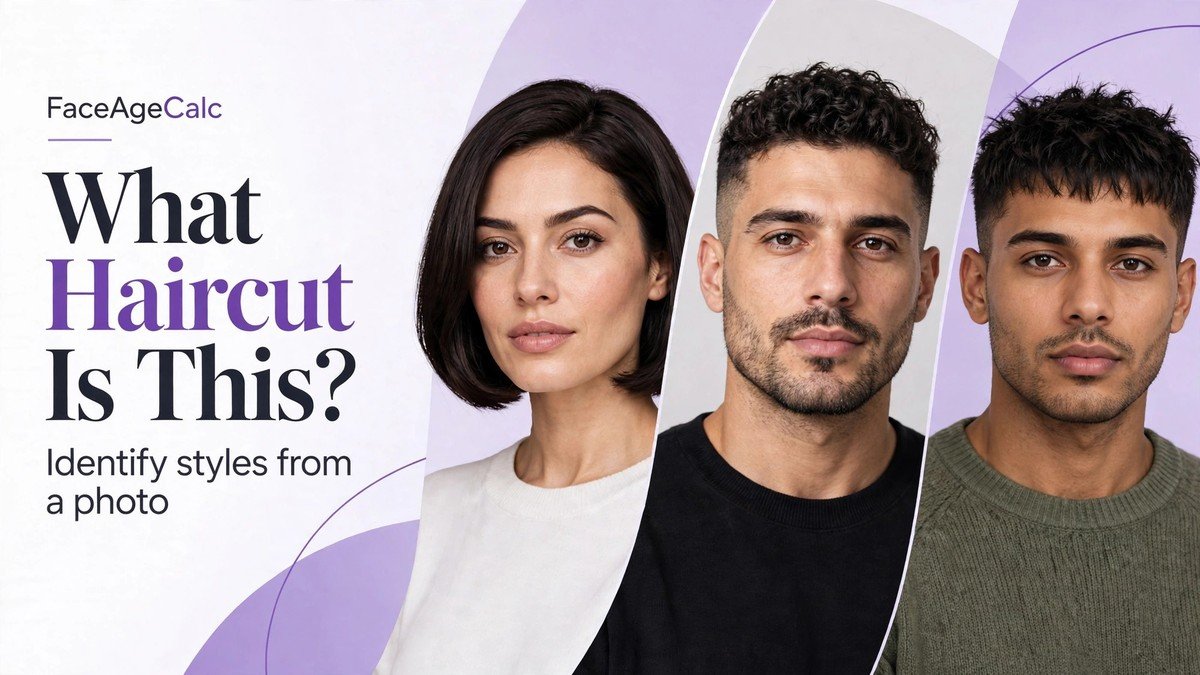
Start With These Five Visual Clues
When you look at a reference photo, inspect the haircut in the same order each time. This makes it easier to describe what you see without relying on a trend name that might mean something different to another person.
- Overall length: Is the hair cropped above the ears, around the jaw, near the collarbone, or below the shoulders? Body landmarks are often easier to communicate than an estimated number of inches.
- Shape and layers: Does the outline look blunt and even, graduated, softly layered, choppy, or longer at the back? Layers may be obvious around the crown or face, or more subtle through the lengths.
- Fringe or front pieces: Is there a straight fringe, curtain bangs, a side-swept section, a short forward fringe, or no fringe at all? The front can change the overall look substantially.
- Texture and finish: Does the hair look sleek, wavy, curly, coily, fluffy, wet-look, or deliberately messy? Some of this effect may come from a blow-dry, styling product, hot tools, braids, or extensions rather than the haircut itself.
- Sides and back: On shorter cuts, look for a fade, taper, undercut, or sides left at a similar length to the top. If the photo only shows the front, this part may be impossible to identify confidently.
A practical method is to write down one observation from each category. For example: “short sides, longer textured top, fringe brushed forward, and a gradual blend near the temples.” That description is already useful even if you never learn the official style name.
Identify Short Haircuts
Short haircuts can share a similar outline while using different lengths and techniques. Check the top, sides, neckline, and fringe rather than assuming that every short cut with faded sides is the same style.
Buzz cut
A buzz cut is very short and usually kept at a fairly uniform length with clippers. Some versions leave the top a little longer or use a fade around the sides, so look closely at whether the lengths are even. If you want to request one, specify the guard length you prefer and whether you want a fade, taper, or natural neckline. Wahl’s clipper and fade guide explains how guide-comb lengths affect the result.
Crew cut and Ivy League
A crew cut keeps the top short, often with slightly more length toward the front, and the sides are generally shorter. An Ivy League is a related, more polished short cut that may leave enough length to part or sweep the front. Photos can make these styles look almost identical, so note whether the front can be combed to the side and how much length remains on top.
French crop and Caesar cut
These cuts keep the top relatively short and bring hair forward toward the forehead. A French crop often has visible texture and a distinct short fringe, while Caesar cuts are also recognized by a short forward fringe and compact shape. The names overlap in everyday use. To communicate the version you like, say whether you want a straight or broken-up fringe, a flat or textured top, and how tight the sides should be.
Fade and taper
A fade describes a gradual transition to very short hair, which may reach bare skin at some point. A taper usually refers to a more localized gradual shortening around areas such as the sideburns and neckline, while more hair remains elsewhere. Barbers and regions may use the terms differently, and “taper fade” is also a common phrase. Rather than argue over the label, show where you want the blend to start and how much scalp you are comfortable showing.
Fade height is another clue: a low fade begins closer to the ears and neckline, a mid fade sits higher, and a high fade rises further up the sides. The same top—such as a textured crop or quiff—can be paired with different fades. For an edgier look, the faux hawk keeps length through the center with tapered sides. Wahl’s fade haircut overview provides a practical reference for understanding the transition and the longer hair left on top.
Undercut
An undercut creates a noticeable contrast between the shorter sides or back and the longer hair above. The transition may look more disconnected than a fade, although undercuts can be blended too. Check whether the longer top hangs over the shorter section, whether the sides are parted away, and whether the undercut is visible only when the hair is tucked or tied back. Wahl’s undercut guide illustrates the basic idea of keeping the top separate from the shorter lower sections.
Identify Medium and Long Haircuts
With medium and long hair, the perimeter and layer pattern are often more informative than the trend name. Look at where the ends fall, whether the bottom edge is blunt or angled, and where the shortest pieces begin.
Bob and lob
A bob is a cut that generally sits around the jaw or above the shoulders, though versions vary in length and shape. A lob—short for “long bob”—keeps more length, often around the shoulders or collarbone. An A-line bob is shorter at the back and longer toward the front, while an asymmetrical bob has visibly different lengths on the two sides. When you identify one, mention where the ends fall and whether the bottom line is blunt, rounded, angled, or layered.
Pixie and bixie
A pixie is a short cut with cropped sides and back, often leaving more length or texture on top. A bixie combines features of a pixie and a bob: it is longer and fuller than many pixies but more cropped than a typical bob. The boundaries are not standardized, so use the names as search terms and then describe the length around the ears, nape, and fringe.
Shag, wolf cut, and mullet
A shag uses layers and texture to create movement throughout the haircut. A wolf cut is a modern, shag-like style that often combines fuller or shorter layers around the crown with longer lengths underneath. A mullet typically has a more noticeable difference between shorter hair at the front and sides and longer hair at the back. The three families overlap in contemporary styling, so the photo may show a hybrid rather than a textbook example.
Long layers and butterfly-style cuts
Long layered hair retains overall length while shorter sections create movement. Face-framing layers begin near a chosen point—such as the cheekbone, jaw, or collarbone—and blend into the rest of the hair. A butterfly cut is commonly described through shorter face-framing layers paired with longer lengths, often styled to look voluminous. Because blow-drying can exaggerate the layers, check whether the photo shows the cut in its natural state or a carefully styled finish.
Fringe and bangs
Fringe describes the hair across the forehead. Blunt bangs form a stronger, more defined line; wispy bangs have a lighter, broken-up appearance; side-swept fringe angles to one side; and curtain bangs part around the centre and sweep away from the face. These are features that can be added to many haircuts rather than separate haircut names by themselves.
Professional cutting education from Sam Villa’s haircutting techniques guide covers foundational cutting, layering, face-framing, and fringe techniques. It is useful context for understanding why two cuts with the same broad name can look different.
Use This Visual Haircut Identification Chart
Use the chart below as a quick reference, not a definitive classification system. It connects common names to the clues that distinguish them. If a style does not match any single box, it may combine elements from several families.
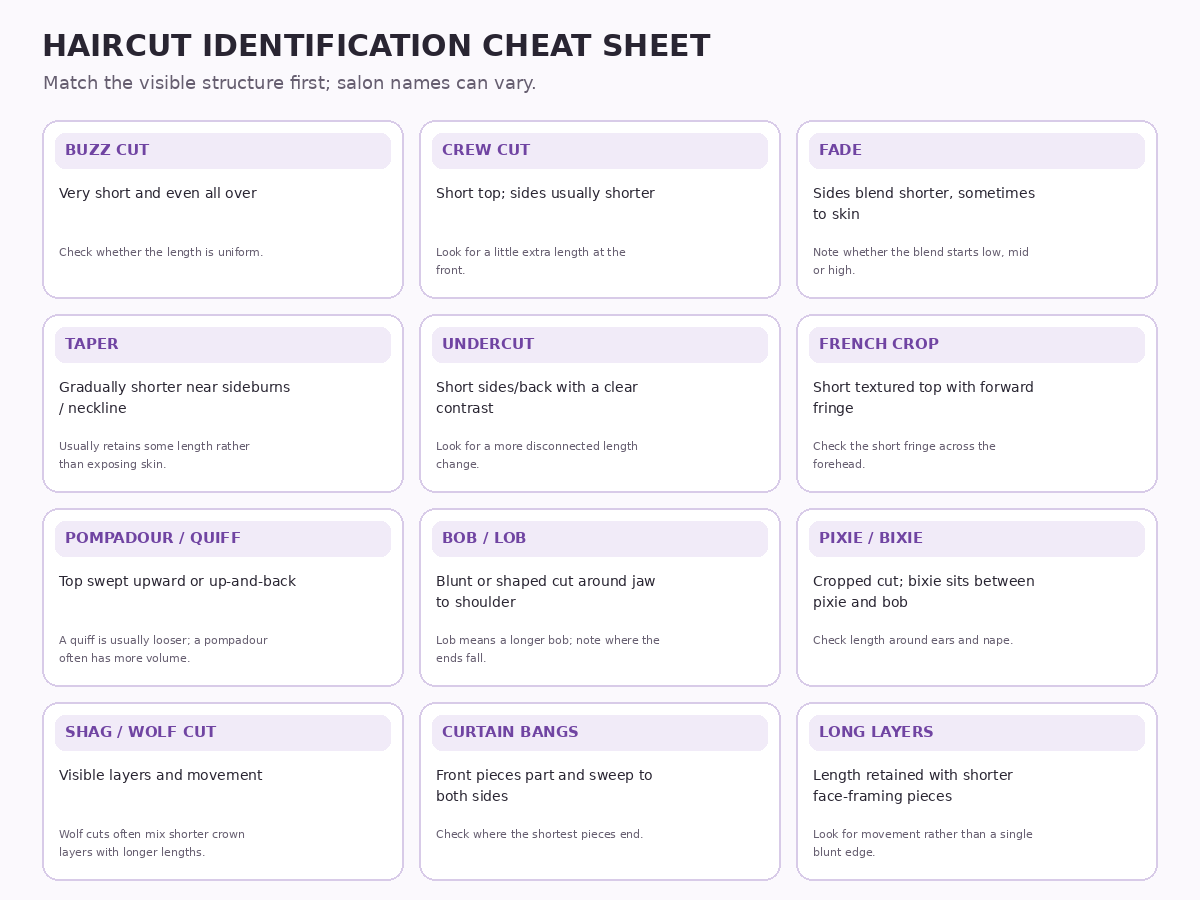
| What you see | Possible haircut family | Detail to confirm |
|---|---|---|
| Very short and even all over | Buzz cut | Whether the sides are the same length or faded. |
| Short top with shorter sides | Crew cut, Ivy League, crop | Front length, direction of styling, and fringe. |
| Gradual blend on the sides | Fade or taper | Whether it reaches skin and where the blend begins. |
| Strong contrast between top and sides | Undercut | Whether the transition is disconnected or blended. |
| Ends near the jaw or shoulders | Bob or lob | Exact end point, perimeter, and angle. |
| Short, cropped shape with textured top | Pixie or bixie | Length around the ears, nape, and front. |
| Lots of visible layers and movement | Shag, wolf cut, long layers | Where the shortest layers begin and whether the back is longer. |
| Front sections open away from the centre | Curtain bangs or face-framing layers | Whether the hair is cut as a fringe or simply parted and styled. |
Separate the Haircut From the Styling
A photo shows the hair at one moment, not necessarily the cut on its own. A round brush can lift the roots, a curling iron can create waves, wax can separate short pieces, and a straightener can make layered hair appear smoother. Braids, twists, wigs, extensions, and hairpieces can also create a look that does not reveal the underlying haircut.
Check the following before deciding on a name:
- Look at more than one angle. The front may hide a fade, undercut, layers, or a longer back. A side view can reveal the silhouette; a back view can show the neckline and graduation.
- Notice what the hair is doing. Is the volume built into the cut, or does it look lifted and curled with styling tools? Is the fringe cut short or simply brushed forward?
- Account for natural texture. A cut may look different on straight, wavy, curly, or coily hair. Curly hair can appear shorter when dry because of shrinkage, while straightened hair may reveal a different outline.
- Look for signs of editing or artificial styling. Heavy filters, image generation, dramatic lighting, and retouching can obscure the real hairline and make a look difficult to recreate exactly.
If the photo is unclear, use a broader description rather than forcing a precise label. “Shoulder-length layered cut with curtain bangs” is more honest and actionable than claiming to know the exact salon technique from a single front-facing image.
How to Describe the Cut at Your Appointment
The haircut name is a useful starting point, but it rarely communicates every detail. Your stylist needs to know what you like about the reference, what should stay different, and how the style needs to work in everyday life. Bring two or three photos if possible, including a side or back view for cuts where those details matter.
Use this consultation checklist:
- Length: Where should the top, fringe, sides, and back end? Use the ears, jaw, cheekbones, or collarbone as reference points.
- Shape: Do you want a rounded, square, tapered, layered, or blunt outline?
- Sides and neckline: Should the sides be faded, tapered, undercut, scissor-cut, or left longer? How much scalp should show?
- Fringe and part: Do you want a forward fringe, curtain bangs, a side part, a centre part, or no defined part?
- Texture and finish: Should the result look sleek, natural, messy, defined, or voluminous? Can it work without daily heat styling?
- Maintenance: How often are you willing to get a trim, and how much time do you want to spend styling?
- What to avoid: Tell the stylist which details you do not want, such as sides cut too high, fringe too short, layers starting too high, or excessive thinning.
A simple script is: “I like this photo because of the [length/texture/fringe/shape]. Please keep [specific detail], adjust [specific detail] for my hair, and tell me what styling it needs at home.” This invites the stylist to adapt the reference instead of copying it without considering your hair.
If you are still unsure, ask the stylist to confirm the plan before cutting: where the shortest section will sit, how much length will be removed, and whether the final look depends on styling. It is easier to clarify those details at the consultation than after a major change.
Frequently Asked Questions
How can I find a haircut’s name from a photo?
Look at the overall length, layer pattern, fringe, texture, and sides or back. Compare those clues with a haircut glossary, then use the closest name alongside a plain-language description. A side or back view can help confirm details that are hidden in a front-facing photo.
What is the difference between a taper and a fade?
A fade usually describes a gradual transition to very short hair that may reach the skin. A taper usually means the hair gets shorter around specific areas, such as the sideburns or neckline, while retaining more length elsewhere. Salon terminology can vary, so show the desired transition in a reference photo.
Is an undercut the same as a fade?
No. An undercut is defined mainly by contrast between shorter sides or back and longer hair above; the transition can look disconnected. A fade is defined by a gradual blend to shorter lengths, sometimes to skin. Some haircuts combine an undercut-like shape with a fade.
Can one haircut have several names?
Yes. Names vary by region, salon, trend, and the details of the cut. A style may combine a French crop with a mid fade, or a lob with curtain bangs. Describe the length, fringe, layers, and sides as well as the name.
Can AI reliably identify a haircut?
An image tool may suggest a likely haircut family, but a single image can hide the sides, back, layers, or styling process. Lighting, filters, curls, wigs, and extensions can also affect the result. Treat an AI label as a starting point and confirm the visible details before asking for the cut.
What should I tell my barber if I do not know the name?
Show a clear reference photo and explain what you like: the length on top, how short the sides are, the fringe, the neckline, and the texture. If possible, bring front, side, and back views. Also explain your normal styling routine and what you want to avoid.