
If you have searched “Why am I so ugly?” you may be feeling hurt, self-conscious, or stuck thinking about how you look. I cannot judge your appearance from a search phrase, and you do not need to prove that you look a certain way to deserve kindness. This guide explores why appearance worries can feel convincing, how comparison and repeated checking may affect you, and where support can help.
Feeling unattractive is an experience, not an objective verdict about your worth. Many people have days when they feel uncomfortable with their appearance. If these thoughts are frequent, distressing, or start interfering with school, work, relationships, or daily activities, it may be worth talking to someone you trust or a qualified mental-health professional.
Feeling Ugly Is Not an Objective Verdict
The thought “I am ugly” can feel like a fact, especially when you are upset, comparing yourself with someone else, or remembering a hurtful comment. But a feeling and a factual conclusion are not the same thing. How you see yourself can shift with mood, stress, sleep, social context, and what you have been focusing on.
This does not mean you should force yourself to feel confident or pretend that appearance never matters. It means you can acknowledge the distress without accepting the harshest thought as the whole truth. Instead of asking “What is wrong with my face?”, you might try asking “What happened today that made this thought louder?” or “What would help me get through the next hour without judging myself?”
It can also help to separate a preference from a verdict. You may dislike a haircut, feel awkward in a photograph, or want to change a style. Those are specific experiences you can address. They do not establish that your entire appearance—or your value as a person—is bad.
This article is educational, not a diagnosis or a substitute for mental-health care. If appearance concerns are causing significant distress, you do not need to wait until they feel “serious enough” to ask for help.
How Comparison Can Affect Your Body Image
People often compare their appearance with friends, celebrities, influencers, edited photos, or idealized images online. Repeated exposure to appearance-focused content can encourage attention toward features you think you lack, especially when images are filtered, carefully posed, or selected to show only a narrow version of beauty.
Research and professional guidance describe associations between some forms of appearance-focused social-media engagement and body-image concerns. That does not mean social media affects everyone in the same way, or that one platform alone explains how a person feels. Offline experiences, personal circumstances, existing worries, and the kind of content someone sees can also matter.
You could try noticing how you feel before and after using particular accounts or apps. If certain content reliably leaves you more distressed, consider muting it, taking a break, or changing what appears in your feed. This is not a demand to leave social media completely; it is a way to make your online environment less punishing.
Try shifting the question from “How do I measure up to this person?” to “Is this content helping me live the way I want to live?” You can admire someone’s style without treating their appearance as a standard you must meet. If comparing feels automatic, a supportive therapist can help you explore the pattern without blame.
How Past Experiences Can Shape Appearance Worries
Appearance concerns can be influenced by many experiences. Teasing, bullying, criticism from family or peers, rejection, relationship difficulties, or repeated comments about weight, skin, hair, or facial features may stay with someone. For others, worries become stronger during stress or a major life change, even without one clear triggering event.
There is no single explanation that fits everyone. A hurtful comment can affect one person deeply and barely register for another; some people experience appearance worries without a history of bullying. You do not need to identify one cause before you are allowed to seek support.
If a comment from the past still comes to mind, it may help to recognize that the person who said it was expressing an opinion or behaving hurtfully—not delivering a reliable measurement of your worth. If you are currently being mocked, harassed, or pressured about your appearance, consider telling someone who can support you and help address what is happening.
Try to be curious rather than critical about your reaction. “That comment still hurts” is a more compassionate starting point than “I should be over it.” If the memories or worries are affecting your relationships, confidence, or daily life, a mental-health professional can help you work through them.
When Checking and Reassurance Become a Cycle
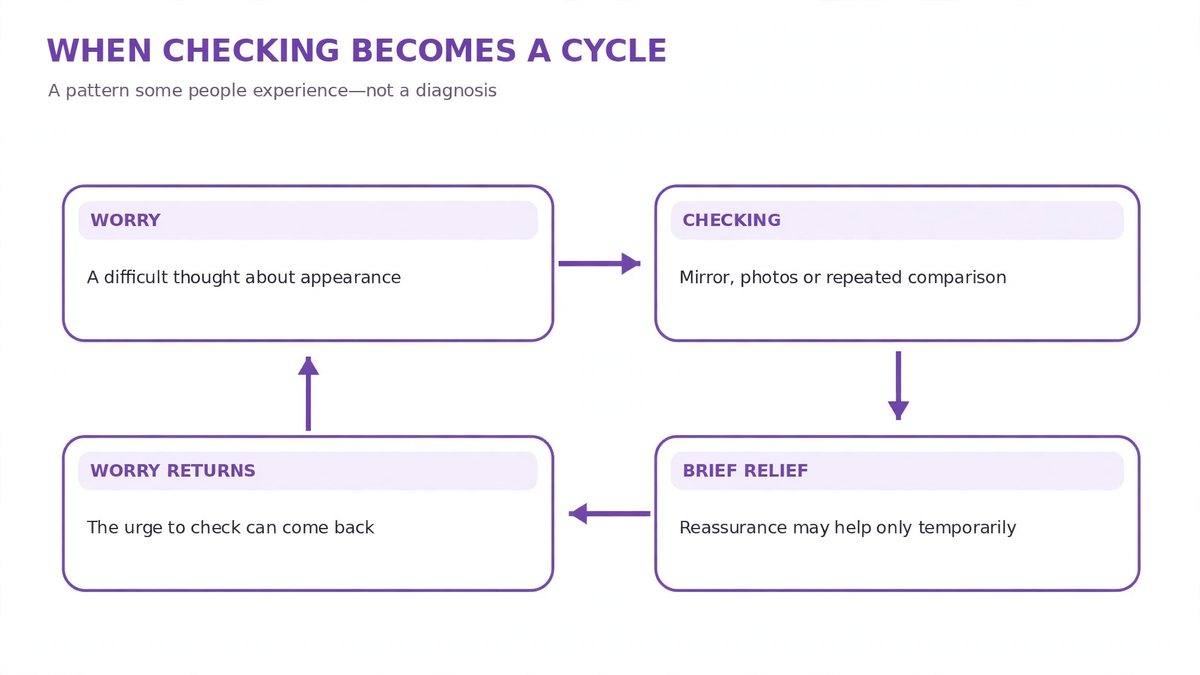
When appearance worries rise, some people check mirrors, take repeated photos, zoom in on particular features, compare themselves with other people, ask for reassurance, or search online for ratings. These actions may bring a little relief for a short time. For some people, though, the doubt returns and the urge to check grows stronger, creating a frustrating loop.
Not everyone who looks in a mirror or asks a friend for reassurance has a problem. Context matters: how often it happens, how difficult it is to resist, how much distress it causes, and whether it gets in the way of everyday life. Repeated checking or reassurance seeking can be especially unhelpful when it becomes the main way a person tries to feel certain about their appearance.
For some people, an attractiveness-rating website or repeated request for a score can become another form of checking. A rating cannot settle every doubt about appearance, and seeking more ratings may keep attention fixed on the concern. That is why this article does not offer a beauty test or encourage readers to submit their faces for a score.
If you recognize this pattern, you do not need to stop every habit all at once. You could notice the urge, pause briefly before acting on it, and choose another activity that matters to you. If checking feels compulsive or causes substantial distress, ask a qualified clinician about evidence-based support rather than relying on self-help alone.
Appearance Insecurity and Body Dysmorphic Disorder
Body dysmorphic disorder (BDD) is a mental-health condition involving persistent preoccupation with perceived flaws in appearance that are not observable to others or seem slight to them, alongside significant distress or impairment. People with BDD may spend substantial time worrying about their appearance and may engage in repetitive behaviours such as mirror checking, grooming, comparing, skin picking, or seeking reassurance. The exact experience varies.
Having an insecure day, disliking a feature, or wanting a different haircut does not automatically mean someone has BDD. The key issues include how persistent and consuming the concern is, the distress it causes, and whether it disrupts work, education, relationships, or other parts of life. Only a qualified professional can assess whether BDD or another condition may be involved.
The NHS overview of body dysmorphic disorder describes the condition, its symptoms, and the way it can affect daily life. The BDD Foundation’s information about BDD also explains common experiences and support options.
If you are concerned that appearance thoughts are taking over your day, you can tell a clinician how much time they occupy, what you do in response, and which activities you have started avoiding. You do not need to decide in advance what diagnosis applies. The purpose of an assessment is to understand what you are experiencing and identify suitable support.
Practical Ways to Respond to a Difficult Body-Image Day
There is no single trick that makes appearance worries disappear, and the suggestions below are not a replacement for treatment. They are gentle options that may help you get through a difficult moment without turning it into another test of your looks.
- Step back from a trigger. If a particular feed, photo session, or conversation is intensifying the worry, take a short break or change the activity. You can decide later whether to return to it.
- Name the thought without arguing with it. Try “I am having the thought that I look terrible” instead of treating the thought as a final verdict. You do not have to prove the thought wrong to let it pass.
- Reduce repeated checking where you can. If you notice yourself taking the same photo or inspecting one feature repeatedly, pause and choose a different activity for a little while. If the urge feels overwhelming, professional guidance may be helpful.
- Reconnect with something you value. Message a friend, take a walk, study, cook, listen to music, or return to an activity that matters to you. The aim is not to distract yourself forever; it is to make room for life beyond appearance worries.
- Use supportive language. You do not need to love every feature today. You can aim for neutrality: “This is my face, and I can still do something meaningful today.”
- Reach out to someone safe. Tell a trusted person what you are experiencing and what kind of support helps. You can ask them to listen without rating your appearance or repeatedly reassuring you.
Choose one small step rather than turning this list into another standard you must meet perfectly. If the worry persists, becomes more intense, or keeps you from normal activities, professional support is a reasonable next step.
When and How to Get Professional Support
Consider speaking with a mental-health professional if appearance worries take up a lot of time, cause intense distress, lead you to avoid social situations, interfere with school or work, or make you repeatedly check or seek reassurance. You do not have to wait until your life is severely affected to ask for help.
You might start with a primary-care clinician, psychologist, psychiatrist, or another qualified mental-health provider available in your area. Explain what the thoughts are like, how often they occur, how they affect your day, and whether you engage in checking, comparison, grooming, or avoidance. If it is difficult to say aloud, writing a few notes beforehand may help.
BDD and other appearance-related difficulties can be treated. Depending on the individual assessment, care may include psychological therapy, such as cognitive behavioural therapy adapted for BDD, and in some cases medication prescribed by a qualified clinician. A professional can explain the options, benefits, risks, and next steps for your circumstances. Avoid treating a general article as a personalized treatment plan.
If you are in immediate danger or feel you might harm yourself, contact local emergency services or go to the nearest emergency department, and reach out to a trusted person who can stay with you. If you are unsure where to find support, a local healthcare provider can help identify appropriate services. Seek help sooner if the distress is becoming difficult to manage.
Support should not depend on whether you believe your appearance concern is justified. You deserve help with the distress itself, regardless of how you or anyone else evaluates a particular feature.
Frequently Asked Questions
Why do I feel unattractive even when people compliment me?
Compliments may not change a negative belief if you are focused on a particular feature, comparing yourself with others, or finding it difficult to trust reassurance. This does not prove that your negative judgement is accurate. If the worry is persistent or affects daily life, consider talking with a qualified mental-health professional.
Can social media make appearance worries worse?
Appearance-focused or idealized content may contribute to comparison for some people, but effects vary and social media is not the only influence on body image. Notice which accounts affect your mood and consider muting or taking a break from content that leaves you distressed.
Does feeling ugly mean I have BDD?
No. Appearance insecurity alone does not establish body dysmorphic disorder. BDD involves persistent preoccupation, distress, and often repetitive behaviours or interference with daily life. A qualified clinician can assess your experience if you are concerned.
Why do I keep checking my appearance?
Checking can be an attempt to reduce uncertainty or feel reassured. For some people, relief is brief and the urge to check returns, creating a cycle. If checking is difficult to control or takes up significant time, professional support may help.
Will an attractiveness score make me feel better?
A score cannot reliably measure your worth or settle every appearance worry. Repeatedly seeking ratings may keep attention fixed on the concern and may be unhelpful for some people. This article recommends support and practical coping rather than appearance scoring.
When should I talk to a mental-health professional?
Consider reaching out when appearance concerns are persistent, distressing, time-consuming, or interfere with relationships, work, school, or everyday activities. You can describe the thoughts and behaviours without diagnosing yourself first.