
It usually lands without warning. Someone guesses your age five years too high. Or a photograph stops you mid-scroll, because the face in it looks older than the one in your bathroom mirror this morning. Your birth year did not change overnight — so what did?
What changed is your perceived age: the age other people — and cameras — read from your face. Research on perceived age shows it is built from a surprisingly short list of visible signals, and most of them are not your birth year. Some are habits you can change this week. One of them is the camera in your hand. And one of them you were simply born with. Here are the seven reasons that do most of the work, what the science actually says about each, and what — honestly — can and cannot be done about them. If you want to see what age a photo of you reads as right now, start with our guide to what AI can tell from your photo — or see how an AI age guesser makes the call in the first place.
The Short Answer: 7 Reasons in 7 Lines
- The sun. UV (ultraviolet) radiation is behind most visible facial aging — more than the calendar is.
- Sleep debt. A few short nights show on skin fast, and tired faces get guessed older.
- Your camera. A close phone lens and harsh light can add years that are not really there.
- Stress, and its habits. Cortisol, smoking, alcohol and sugar all work on collagen.
- Lost padding. Faces thin with age and rapid weight loss, and hollows read as older.
- The frame. Brows, teeth, hair, posture and makeup choices shift the guess by years.
- Your genes. The baseline you started from. This one cannot be edited — only worked with.
The 6 Signs That Give It Away
Before the reasons, a useful piece of research. In a 2024 study in Scientific Reports, dermatologists scored 21 clinical signs on the faces of 351 women aged 36–73 from France and Romania. Six signs — facial elastosis, papery cheek texture, cheek folds, crow's-feet wrinkles, upper-lip wrinkles and forehead shine — together explained 59% of the variation in chronological age in that study's model (Foucher et al., 2024). Read that carefully: it is a finding about one clinical model in one group of women, not a universal formula for how old anyone looks. But it confirms the shape of this whole article — age guesses are built from a short list of visible signs, and most of those signs have causes you can influence.
1. The Sun Did Most of It
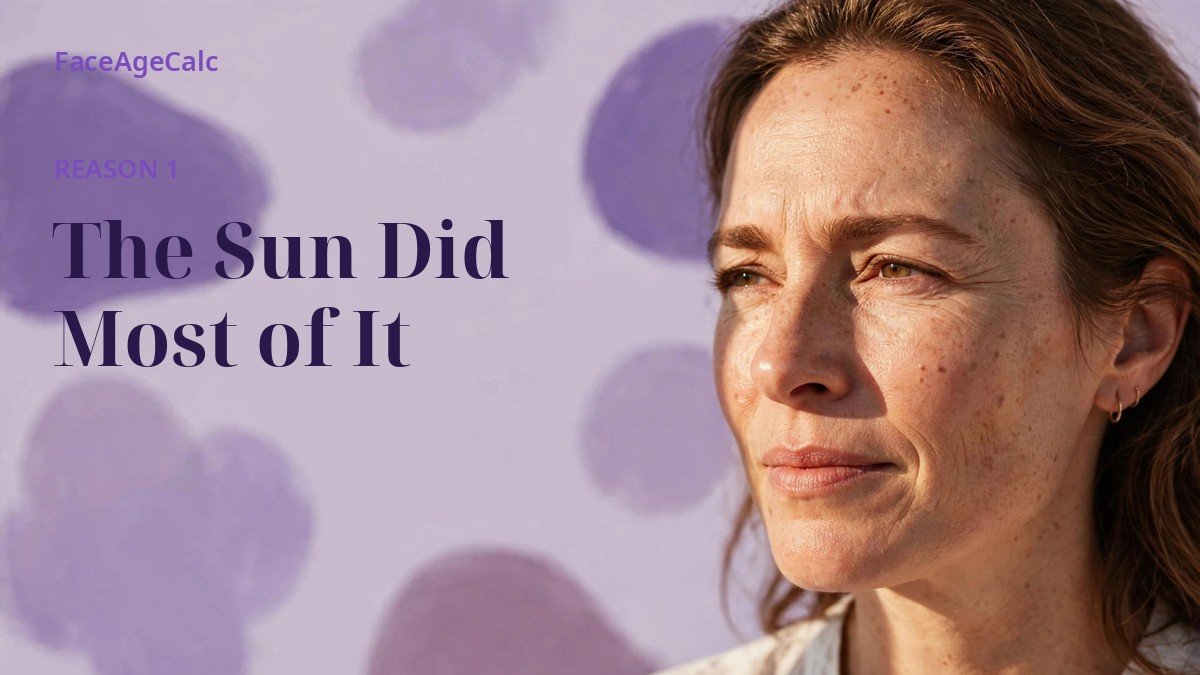
If you change one thing after reading this page, make it this one. In a widely cited study of Caucasian women, researchers estimated that UV exposure was responsible for about 80% of visible facial aging signs — wrinkles, pigmentation and texture changes — with chronological aging itself accounting for the rest (Flament et al., 2013). Dermatologists call this photoaging: aging driven by light, layered on top of the aging driven by time.
The most famous illustration is a medical photograph of a truck driver whose window-side cheek aged dramatically more than the other side after decades of sun through glass. Same UV radiation — one face, two outcomes. You do not need a truck. Ordinary daily exposure — the walk to the car, the desk by the window, the school run — accumulates quietly, because UVA rays pass through cloud and glass and reach the dermis, where collagen and elastin give skin its firmness. UV breaks those fibres down faster than your body rebuilds them, and it generates free radicals whose oxidative stress damages skin cells while quiet, low-grade inflammation slows the repair work.
What helps: daily sunscreen (SPF 30 or higher) on the face, shade at midday, sunglasses. Be clear about what this does: it mostly stops you adding new damage. It is the highest-value habit on this page, and it starts paying off the day you begin — but it prevents far more than it repairs. The strongest evidence is about prevention over years: in a randomized trial of 903 adults under 55, people assigned to daily sunscreen showed no detectable increase in skin aging after 4.5 years, with 24% less progression than the discretionary-use group (Hughes et al., 2013).
2. You Are Running on Empty Sleep
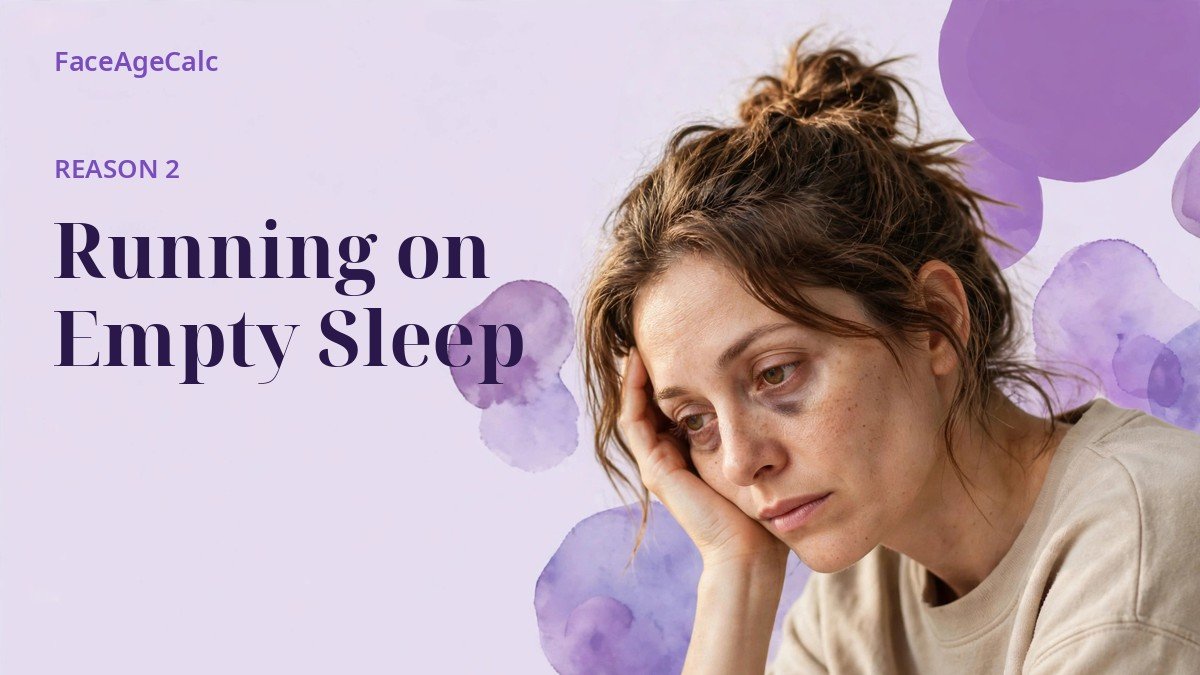
Skin does much of its repair work at night, and it shows when that work gets skipped. After poor sleep, faces look measurably more tired: paler skin, darker under-eye circles, puffiness, drooping eyelids and mouth corners. Observers read that cluster of signals as older — and sadder, and less healthy — even when nothing about the face has permanently changed. In a BMJ experiment, observers rated the same people after sleep deprivation as more tired, less healthy and less attractive (Axelsson et al., 2010). Chronic short sleep is worse: studies of habitual poor sleepers link it to more visible signs of skin aging and a skin barrier that recovers more slowly from everyday stress, with the stress hormone cortisol part of the mechanism.
What helps: a consistent seven to nine hours. The encouraging part: the tired component of looking older is the fastest thing on this list to reverse. A week of real sleep will not remove a wrinkle, but it can remove the "you look exhausted" reading that adds years to a guess — often within days.
3. Your Camera Is Lying to You
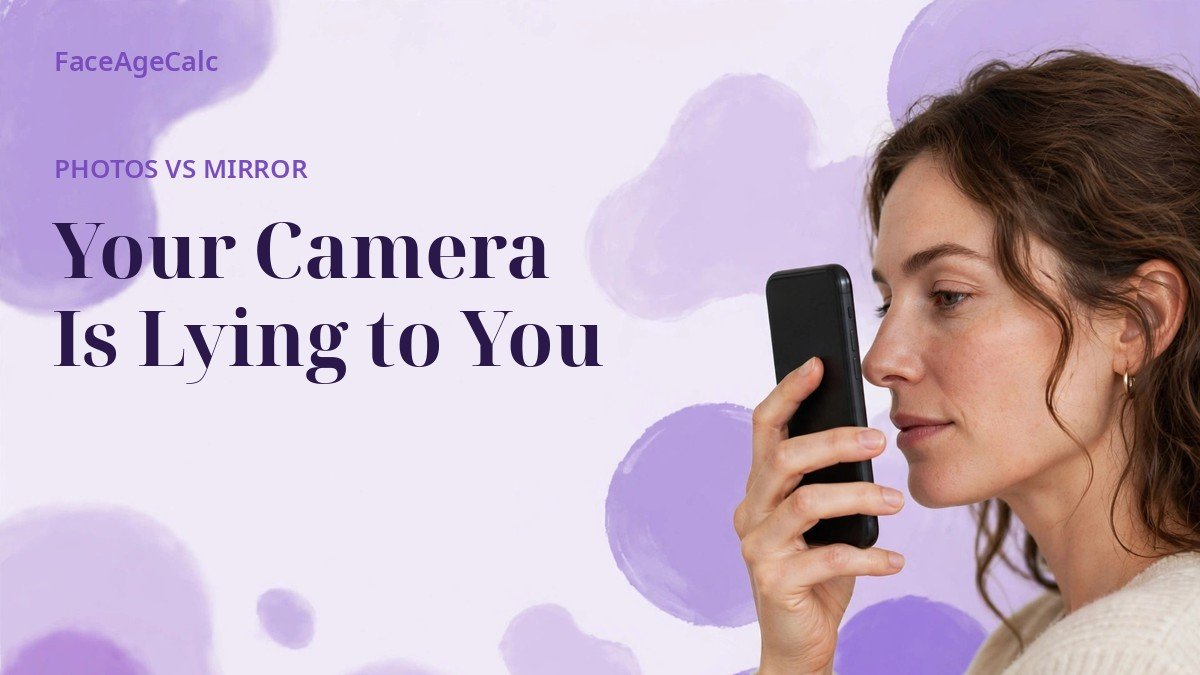
Here is the reason nobody warns you about: the face in your selfie is not the face people meet. A phone camera held at arm's length uses a wide lens, close to your face — and close wide lenses exaggerate whatever is nearest, stretching the centre of the face and distorting its proportions. Your mirror, meanwhile, shows you a flipped, familiar, living face that you unconsciously pose for. The photograph freezes one unflattering frame, in one unflattering light, of a version of you that you never actually see.
This deserves its own section, because it explains the most common version of this whole question — so it gets one, just below: why you look older in photos than in the mirror, and the two-minute fix.
4. Stress — and the Habits That Travel With It
Long-running stress keeps cortisol elevated, and cortisol works against collagen — the protein scaffold that keeps skin firm. Stress also writes itself onto the face mechanically: months of frowning and jaw-clenching deepen the expression lines that go with them. And stress rarely travels alone. The habits that cluster around it are each hard on skin in their own right:
- Smoking narrows blood vessels in the skin and interferes with collagen production; smokers' faces are a textbook example of accelerated visible aging.
- Alcohol dehydrates, disturbs sleep and shows up the next day as puffiness and dullness; heavy use over years adds broken capillaries and persistent redness.
- Sugar drives a process called glycation, in which sugar molecules stiffen collagen and elastin fibres, reducing skin elasticity.
What helps: you already know the list — the honest version is that each habit you remove stops a specific, ongoing form of damage. Quitting smoking, for example, improves skin circulation within weeks. None of this is about blame; it is about which levers actually connect to the outcome.
5. Your Face Lost Its Padding
Young faces are, in a word, padded. Compartments of facial fat sit high in the cheeks and around the eyes, and that fullness is one of the strongest signals of youth. With age those fat pads shrink and shift downward. The result is not just wrinkles — it is hollows under the eyes, deeper folds around the mouth, early sagging along the jaw, and shadows where light used to bounce. Shadows read as age.
This is also why rapid weight loss can make someone look older almost overnight, even when the weight loss itself is healthy: the face loses volume faster than skin can adapt. This volume loss is a change in structure, not damage, which is why no cream refills it. Gradual change is kinder to the face than fast change — and if weight is dropping without you trying, that is a reason to see a doctor, not a search engine.
6. It Is Not Your Skin — It Is the Frame
Age guesses are made from the whole picture, and some of the picture is not skin at all:
- Eyebrows thin and lighten with age; faint brows remove contrast from the face, and contrast reads as youth.
- Teeth darken and wear; a smile is one of the first things a guess is built from.
- Hair — greying changes the frame, and so do hairstyle and colour choice: hair dyed much darker than your skin tone can throw harsh contrast onto every line.
- Posture matters more than people expect: rounded shoulders and a forward head are read, instantly, as older.
- Makeup can add years when it fights the skin: heavy matte foundation settles into fine lines and emphasises texture instead of hiding it.
What helps: this is the cheapest section on the page. Brow definition, dental care, a hair colour within a shade or two of your natural tone, lighter makeup textures, and standing up straight can move a guess by years — without touching the skin itself.
7. The Cards You Were Dealt
Finally, the baseline. Aging patterns run in families — look at how your parents' faces aged and you are probably looking at your own trajectory, give or take the habits above. Researchers have linked specific gene variants to perceived age; the best-known involves MC1R, a gene associated with red hair and fair skin, variants of which are associated with looking somewhat older or younger than one's age. Bone structure plays a part too: strong cheekbones and a defined jawline hold facial tissue up longer than softer structures do.
This reason is last because it is the one you cannot change — and it is worth saying plainly: genetics loads the dice, but for most people it does not roll them. The six reasons above decide how fast you travel along the track your genes laid down.
Skin Aging vs Maturity Cues — At a Glance
One distinction the forum threads on this topic keep bumping into: not everything that makes a person look older is skin aging. Some of it is maturity cues — signals of adulthood that say nothing about how fast your skin is aging:
| Age cue | Why it may affect an age guess | What it does not prove |
|---|---|---|
| Early greying or a receding hairline | Hair colour and density frame the face and can signal maturity. | They do not, by themselves, prove that facial skin is aging faster. |
| Facial hair or beard shape | A beard or moustache can change the apparent jawline and the overall impression of maturity. | There is no reliable number of years a grooming change will add or remove. |
| Facial structure and volume | A naturally angular face, deep-set eyes, or less cheek fullness can create contours and shadows that some people read as older. | These features are not automatically signs of poor health or premature aging. |
| Expression, posture, styling, and context | A furrowed brow, serious expression, posture, clothing, or work setting may influence how mature someone seems. | An age guess can reflect context and demeanor — not just skin. |
| Skin texture, folds, and pigmentation | These are visible skin cues that can be influenced by cumulative UV exposure, natural aging, and other factors. | A single photo cannot identify the cause or diagnose a condition. |
Why You Look Older in Photos Than in the Mirror
This is the version of the question our readers ask most, so here is the full answer. Four things conspire against you in a photograph:
- Lens distance. A selfie is usually taken 30–40 cm from the face with a wide-angle lens (a short focal length). At that distance, the nose and chin — being closest — are rendered proportionally larger, while the ears and hairline shrink back. The result is a subtly distorted face that reads heavier and older. Step back, and the same face normalises. This is measured, not imagined: in a 2024 study in The Laryngoscope, smartphone photos taken at 8 inches stretched measured midface features vertically by 18%, and at 12 inches by 12% (Derakhshan et al., 2024). Those figures describe distortion in a photograph, not years added to a face — but they show why a close selfie is a poor witness.
- The mirror is flipped. You have spent your whole life looking at your reversed face, and familiarity breeds preference: your mirror face looks "right" to you. A photo shows the un-flipped version everyone else sees — unfamiliar to you, and easy to judge harshly.
- The mirror moves; the photo doesn't. In the mirror you are lit by your usual light, holding your usual expression, micro-adjusting without noticing. A photo catches one frozen expression — mid-blink, mid-word — that your living face never actually rests in.
- Light carves shadows. Overhead and on-camera flash lighting digs shadows under the brow, eyes and nose — exactly the hollows that read as age. Window light from the front erases half of them.
The two-minute fix: hold the phone farther away (or use the 2x/portrait lens), face a window instead of standing under a ceiling light, and take several shots rather than judging the first. Photographers have known this forever; it is also why the same photo conditions change what an AI estimates from your face — we break down those factors in our guide to how accurate AI age detection is.
Looking Older in Your 20s and 30s
"I'm 24 — why do I already look older?" is its own search, and the answer is reassuring: in your twenties and thirties, looking older is rarely about aging itself. Skin cell turnover is still fast and collagen loss has barely begun. What people are seeing is almost always the reversible stack: sleep debt from work or young children, stress load, sun habits picked up in your teens starting to surface as pigmentation and sun spots, dehydration, weight swings, and a front-camera habit that flatters no one.
Two honest cautions. First, comparison is rigged: you are comparing your unfiltered face to the filtered faces in your feed, which is not a comparison — it is a distortion. Second, genuinely sudden changes — rapid hair loss, major skin changes, unexplained weight change — deserve a doctor or dermatologist, not a blog post. Everything else on this page applies to you with better odds: at 25, nearly all of it is inputs, and inputs can change.
The Flip Side: Why Some People Look Younger
It is tempting to assume the friend who looks 35 at 48 has a secret. The largest relevant study suggests something less marketable. In a Danish study published in the BMJ, researchers photographed 1,826 twins aged 70 and over and had assessors guess their ages. Over the following seven years, the twin who looked younger was significantly more likely to survive — and the wider the gap in perceived age within a pair, the more likely the older-looking twin was to die first. The younger-looking twins also tended to have longer telomeres, a marker of cellular aging. In other words, perceived age is a rough public reading of biological age — it is not vanity, and it tracks real biology closely enough that clinicians use it as a biomarker.
Which reframes the whole question. People who look younger usually do not have a trick; they have a different stack: favourable genes, less accumulated sun, more sleep, no smoking. Boring inputs, compounding quietly for decades. If you are curious what age your own face currently reads as, our free age calculator by photo will estimate it from a single photo — privately, in your browser, without your photo ever leaving your device.
Can You Look Younger Again? What Actually Changes — and How Fast
Honesty first: you cannot negotiate with your birth year, your bone structure or your genes, and anything promising to "reverse aging" wholesale is selling something. But "looking older than your age" is usually a stack of separate effects, and several of them genuinely do reverse:
- The tired look (sleep, dehydration): days to a few weeks. The fastest, most underrated change on this page.
- Smoking-related dullness: circulation improves within weeks of quitting; skin tone follows over months.
- Sun damage: sunscreen prevents new photoaging starting today. Existing damage improves only partly and slowly — some retinoid treatments have clinical evidence for improving photoaged skin texture over months of use, and a dermatologist can advise what suits your skin.
- The frame (brows, teeth, hair, posture, makeup): as fast as you can book, buy or build the habit — days.
- Lost volume, bone structure, genetics: not reversible with lifestyle. Anyone who tells you otherwise is marketing.
The realistic goal is not to look younger than your age. It is to stop looking older than it — and that, for most people, is mostly a matter of removing the accelerants stacked on top of a perfectly normal face.
Frequently Asked Questions
Why do I look older in photos than in the mirror?
Three reasons: your phone's wide lens, held close, exaggerates the centre of your face; the mirror shows a flipped, familiar version of you that you unconsciously pose for, while a photo freezes one expression in one light; and overhead or flash lighting carves shadows into exactly the hollows that read as age. Stepping back, using the 2x lens and facing a window fixes most of it.
Why do I look older than my age at 20?
At 20 it is almost never actual aging — collagen loss has barely begun. The usual stack is sleep debt, stress, dehydration, sun exposure from your teens starting to show as pigmentation, weight swings, and unflattering front-camera photos. Nearly all of it is reversible inputs. Sudden real changes, like rapid hair loss or major skin changes, are worth a doctor's visit.
Does losing weight make you look older?
It can, especially when it is fast. Faces read as young partly because of fat padding in the cheeks and around the eyes; rapid weight loss removes that volume faster than skin can adapt, leaving hollows and shadows that read as older. Gradual loss is kinder to the face. The effect is about volume, not health — and unexplained weight loss should always be checked by a doctor.
Can makeup make you look older?
Yes — mainly when it fights the skin. Heavy matte foundation settles into fine lines and emphasises texture, and hair or brow colours much darker than your natural tone add harsh contrast that throws lines into relief. Lighter, dewier textures and colours within a shade or two of your own usually read younger.
Can you start looking younger again?
Partly — and it depends which reason is doing the work. The tired look from poor sleep and dehydration can fade in days to weeks. Smoking-related dullness improves over weeks to months after quitting. Sun damage improves only partly and slowly. Lost facial volume, bone structure and genetics do not reverse with lifestyle, whatever the marketing says.
Why do some people look younger than their age?
Usually a stack of favourable inputs rather than a secret: genes (variants in genes such as MC1R are linked to perceived age), less accumulated sun, better sleep, and not smoking. A large Danish twin study published in the BMJ found that looking younger even predicted longer survival — perceived age tracks real biology, which is why the inputs matter.
How much does sleep affect how old you look?
More than most people expect, and faster than anything else on this page. After poor sleep, faces show paler skin, dark circles, puffiness and drooping mouth corners, and observers guess those faces older and less healthy. Chronic short sleep is also linked in studies to more visible signs of skin aging. The tired component can improve within days of proper sleep.
Why do I suddenly look older?
Sudden change is usually a stack arriving at once: a run of bad sleep, stress, illness, rapid weight change, a new medication, changes in hormones, or simply a run of bad photos in bad light. Check the reversible causes first. But if the change is dramatic, persistent and unexplained — especially with hair loss, skin changes or weight loss you did not choose — see a doctor rather than a search engine.
Is it normal to look older than your age?
Yes. Perceived age varies by years around chronological age in everyone, and studies of twins show it is influenced by genes, sun, sleep and habits — not by anything being wrong with you. Looking a few years older than your age is common and, on its own, not a health warning sign.
When should I get a sudden change in my appearance checked?
Get it checked if the change is fast, persistent and unexplained — especially rapid hair loss, a new or changing skin growth, a sore that does not heal, significant weight change you did not choose, or changes appearing on only one side of the face. Those deserve a doctor or dermatologist, not a blog or an app. Ordinary looking-older worries are common and usually harmless; visible red-flag changes are the exception worth acting on.
Research Sources
- Flament F, et al. "Effect of the sun on visible clinical signs of aging in Caucasian skin." Clinical, Cosmetic and Investigational Dermatology (2013). Full study.
- Hughes MCB, et al. "Sunscreen and prevention of skin aging: a randomized trial." Annals of Internal Medicine (2013). Study record.
- Foucher A, et al. "Clinical vs. chronological skin age: exploring determinants and stratum corneum protein markers of differential skin ageing in 351 healthy women." Scientific Reports (2024). Original study.
- Axelsson J, et al. "Beauty sleep: experimental study on the perceived health and attractiveness of sleep deprived people." BMJ (2010). Study.
- Derakhshan A, et al. "Quantifying Facial Distortion in Modern Digital Photography." The Laryngoscope (2024). Study record.
- Liu F, et al. "The MC1R Gene and Youthful Looks." Current Biology (2016). Study record.
- Christensen K, et al. "Perceived age as clinically useful biomarker of ageing: cohort study." BMJ (2009). Study.
- "Topical tretinoin for treating photoaging: a systematic review of randomized controlled trials." Journal of Dermatological Treatment (2022). Review.
- Kadunce DP, et al. "Cigarette smoking: risk factor for premature facial wrinkling." Annals of Internal Medicine (1991). Study record.
The questions in this article were shaped by what real people ask in public discussions of this topic — including a Reddit thread titled "Why do some people look so much older for their age?" The answers rely only on the published studies above, not on forum anecdotes.